
Matthew J. Mayhew, The Ohio State University; Christa Winkler, Mississippi State University, and Musbah Shaheen, The Ohio State University
Our research team has studied college students’ attitudes toward evangelicals, a topic that tends to prompt strong reactions.
Some liberals don’t see the topic as worthy of discussion – why study whether Americans appreciate a privileged group with strong influence on society? Meanwhile, many conservatives are adamant that evangelical perspectives are not tolerated, let alone welcome, on U.S. university campuses.
Yet our findings about students’ attitudes underscore important lessons about fostering tolerance and appreciation on campus for any group. Views of evangelicals are particularly interesting, since they highlight the complexities of social privilege: how individuals can feel discriminated against, even when their community as a whole is influential.
Surveying students
The Interfaith Diversity Experiences and Attitudes Longitudinal Survey, or IDEALS, surveyed 9,470 college students from 122 institutions across the country at three times: the beginning of their first year, the end of their first year, and the end of their senior year, which wrapped up in spring 2019. As part of this project, conducted by a team of researchers from Ohio State University, North Carolina University and the nonprofit Interfaith America, we asked students about their attitudes toward religious, spiritual and secular groups, including but not limited to atheists, Jews, Muslims and evangelicals.
We asked students to indicate their responses to four statements on a scale of 1, or “disagree strongly,” to 5, or “agree strongly”:
1) In general, people in this group make positive contributions to society.
2) In general, individuals in this group are ethical people.
3) I have things in common with people in this group.
4) In general, I have a positive attitude toward people in this group.
Our analysis controlled for other variables – such as the institution’s type, selectivity and size, and students’ race, gender, sexual orientation, major and political affiliation – to home in on the specific ways the campus learning environment was related to students’ views about different religious groups.
Compared with their attitudes toward other religious groups on campus, students’ appreciation for evangelicals grew at a slower pace, but still grew. On average, students’ responses showed an increase of over 40% in appreciation toward evangelicals by the end of their first year. By the time students graduated, they demonstrated another 30% increase between the end of their first year and fourth year of college.
Campus climate
After seeing that students’ views of evangelicals improved, on average, we wanted to better understand why.
First, we looked at the experiences students said were related to their gains, such as whether they took a religious studies course. Then, we conducted 18 case studies at institutions of various sizes and affiliations to learn about campus culture and hear from hundreds of students in focus groups. In these groups, we showed students data on the gains reported by their peers on campus and asked them why they thought these gains were made.
We found that appreciation increased for students on campuses they consider committed to inclusion for people of faiths, and people of no faith – regardless of whether the institutions were public or private, large or small, selective or not.
Some students talked about the impact of simply living and studying alongside people from different backgrounds. Many named the influence of interfaith and multifaith centers, spaces dedicated to bringing people from different religions together.
For example, a student at a Protestant-affiliated institution who identified as agnostic noted that she had “experienc[ed] a lot of toxic Christianity” growing up. She credited her interactions with a “progressive Christian” chaplain at her campus’s interfaith center with helping her understand that Christian beliefs and identities are diverse, and not limited to the type of faith she was introduced to as a child.
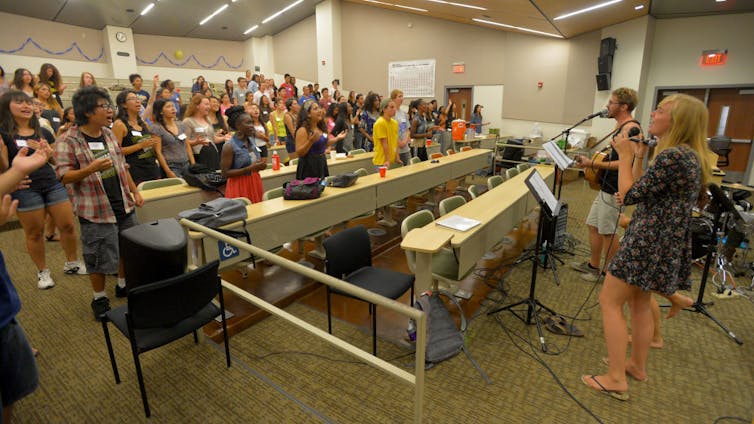
Survey data also suggested that, on average, students whose views of evangelicals improved reported having at least two curricular experiences related to religion. This included many type of activities: for example, enrolling in a course specifically designed to enhance knowledge of different religious traditions; reflecting on one’s own religion in relationship to other perspectives as part of a class; and discussing other students’ religious or nonreligious backgrounds in class.
Personal relationships
How students related to one another was another important theme that often came up in discussions about views of evangelicals.
Evangelicals have to negotiate a seeming paradox: As Protestant Christians, who have long held influence in U.S. culture and politics, they belong to a privileged group. Yet many evangelical students say they feel unwelcome and misunderstood because of their beliefs.
Many non-Christian students who themselves feel marginalized because of their identities wrestle with how to make their evangelical peers aware of their relative privilege, and of how their beliefs and actions might affect other students.
For example, one student who identifies as atheist at a small, secular college recalled a Christmas tree put on their door by another student. “The person has literally no idea that that could possibly be upsetting,” they said, but added it was “a very sweet thing to do.” In other words, they believed that the other student was likely ignorant of why the Christmas tree could bother other students, but acting out of good intentions, tempering their anger about the unwelcome decoration.
Many students discussed developing empathy and humility. A Catholic student attending a Catholic college summarized, “Myself being a more liberal Christian, I’m not as accepting of the close-minded evangelical Christian … but that’s kind of being close-minded myself. … So I have to examine myself and be like, ‘I’m okay with them being them, even if I don’t agree with them.’ They’re saying, ‘All of these people are saying let’s accept everybody, but you’re not accepting me.’ And I said, ‘That’s absolutely right.’ … Even in political realms, too, I don’t agree with you, but I need to be okay with you.”
Finally, student gains in appreciation also seemed to stem from recognition that evangelicals are diverse, not one homogeneous group – as with the student who appreciated her conversations with the Christian chaplain at her campus’s interfaith center.
As a research team, we found this project’s findings left us considering ways to address deep divisions in the U.S. today. Some principles apply to fostering respect in many other situations beyond religion, and beyond college, from our offices at work to the halls of Congress: intentionally but empathetically engaging with one another’s differences.
Matthew J. Mayhew, Professor of Higher Education, The Ohio State University; Christa Winkler, Assistant Professor of Higher Education Leadership, Mississippi State University, and Musbah Shaheen, PhD student in Higher Education and Student Affairs, The Ohio State University
This article is republished from The Conversation under a Creative Commons license. Read the original article.
 Dovestar