Wabi Sabi: The Zen Way of Appreciating the Beauty of Imperfection and Impermanence

Life is a journey full of twists and turns, ups and downs, joys and sorrows. Nothing stays the same, and everything is constantly changing. This can be scary, frustrating, and painful for many of us who want things to be perfect and permanent. However, there is another way of looking at life that can help us embrace the beauty of imperfection and impermanence: the Japanese philosophy of wabi-sabi.

What is wabi-sabi?

Wabi-sabi is a term that means finding beauty in the imperfect, impermanent, and simple things in life. It is a way of feeling and living that goes beyond words. Wabi-sabi comes from the tradition of the Japanese tea ceremony that values simplicity and naturalness as expressions of Zen Buddhism. Wabi-sabi teaches us to accept imperfection and impermanence as part of life’s beauty.

How did wabi sabi help me accept imperfection and impermanence?

Wabi-sabi helped me accept imperfection and impermanence in many ways:

  • It helped me see beauty in the ordinary. Instead of looking for what was missing, wrong, or broken, I started to appreciate what was there, unique, and authentic. For example, I learned to love the cracks in my favorite mug that showed its history and character, or the fading colors of the flowers that marked the passing seasons.
  • It helped me cultivate gratitude for what I have. Instead of taking things for granted, complaining, or comparing, I learned to acknowledge the blessings and gifts that I enjoy in each moment. For example, I learned to be thankful for the food I eat, the people I love, and the opportunities I encounter.
  • It helped me let go of attachment and control. Instead of clinging to things that were temporary, resisting change, or forcing outcomes, I learned to accept things as they are, flow with change, and trust the process. For example, I learned to release my expectations of how things should be, adapt to new situations, and embrace uncertainty.
  • It helped me simplify my life. Instead of accumulating more stuff, cluttering my space, or complicating my choices, I learned to reduce what was unnecessary, clear my environment, and focus on what matters. For example, I learned to declutter my home, donate what I don’t need, and prioritize my values.

How can you practice wabi-sabi in your daily life?

Here are some practical ways you can practice wabi-sabi in your daily life:

  • Practice mindfulness. Mindfulness is being aware of the present moment with openness, curiosity, and acceptance. Mindfulness can help you notice the beauty of imperfection and impermanence in yourself, others, and nature. You can practice mindfulness by paying attention to your breath, body sensations, thoughts, emotions, and surroundings.
  • Practice self-compassion. Self-compassion is being kind and understanding to yourself when you suffer or fail. Self-compassion can help you accept your imperfections and limitations as part of being human. You can practice self-compassion by speaking to yourself with kindness, acknowledging your feelings without judgment, and giving yourself comfort and support.
  • Practice gratitude. Gratitude is being thankful for what is valuable and meaningful to you. Gratitude can help you accept impermanence by reminding you of what you have rather than what you lack or lose. You can practice gratitude by writing down what you are grateful for each day, expressing your thanks to others, or savoring positive experiences.
  • Practice creativity. Creativity is being able to generate new ideas or products that are original and useful. Creativity can help you accept imperfection by embracing mistakes as opportunities for learning and growth. You can practice creativity by trying new things, experimenting with different materials or methods, or making something out of nothing.

Conclusion

Wabi-sabi is a philosophy that teaches us how to accept imperfection and impermanence as part of life’s beauty. By practicing wabi-sabi in our daily lives, we can live more peacefully, joyfully, and meaningfully.

I hope this blog post inspired you to look at life differently and embrace wabi-sabi as a way of living. Remember that you are beautiful just as you are and that everything changes for a reason. May you be happy, healthy, and free from suffering.


Some Related / Helpful Links

The Benefits of Zen in Modern Society

Zen is more than just a form of Buddhism, it is a way of living that teaches us how to be mindful, compassionate, and creative. Zen originated in China and spread throughout Asia, influencing many cultures and traditions. Zen is not a religion that requires belief or worship, but a practice that helps us discover our true nature and potential.

Zen can be very beneficial for us in this modern society, where we face many challenges and distractions. Here are some of the benefits of Zen:

  • Zen can help us cope with stress and anxiety. By meditating regularly, we can calm our mind and body, and focus on the present moment. Meditation can also improve our health, by lowering our blood pressure, boosting our immune system, and enhancing our mental clarity.
  • Zen can help us develop compassion and empathy. By being mindful of our thoughts, emotions, and actions, we can become more aware of how they affect ourselves and others. We can also learn to appreciate the interconnectedness of all life forms and respect their diversity.
  • Zen can help us unleash our creativity and innovation. By trusting our intuition, we can access our inner wisdom and inspiration. We can also learn to embrace uncertainty and change, rather than fear them. Zen can help us see things from different angles and find new solutions to problems.
  • Zen can help us enrich our lives and happiness. By practicing gratitude, we can recognize the blessings and opportunities we have in our lives. We can also learn to enjoy the simple joys of life, such as nature, art, music, or food. Zen can help us find meaning and purpose in our lives, rather than chasing after material possessions or fame.

Zen is not something that we can learn from books or lectures. It is something that we have to experience for ourselves, through practice and reflection. Zen is not a destination, but a journey. It is not a goal, but a process.

If you are interested in learning more about Zen, you can start by reading some books by famous Zen masters, such as Thich Nhat Hanh, Shunryu Suzuki, or D.T. Suzuki. You can also join a local Zen center or group, where you can meet other practitioners and receive guidance from teachers. You can also try some online resources, such as podcasts, videos, or apps that offer meditation instructions and tips.

Zen is not a one-size-fits-all solution for everyone. It is a personal path that you have to discover for yourself. However, if you are willing to give it a try, you might find that it can bring positive changes to your life and society.

I hope you enjoyed this blog post. If you want me to rewrite it or improve it in any way, please let me know.


Some Related / Useful Links

The Uses of Buddhist Philosophy in Modern Society

Buddhist philosophy has been around for thousands of years and has been used by many people to help them live happier and more fulfilling lives. In this blog post, we will explore some of the ways that Buddhist philosophy can be applied in modern society.

The main goal of both Buddhist psychology and philosophy is to eliminate suffering and unhappiness. All of us have a great deal of mental suffering and psychological problems because of emotional difficulties. We have many problems because of being irrational and out of touch with reality. But donโ€™t worry! Buddhist philosophy can help you deal with reality โ€“ how we understand reality and how we deconstruct our fantasies and projections about reality.

One of the most important concepts in Buddhist philosophy is the Four Noble Truths. The first noble truth is that life is suffering. The second noble truth is that suffering is caused by craving and attachment. The third noble truth is that suffering can be overcome by eliminating craving and attachment. The fourth noble truth is that the way to eliminate craving and attachment is through the Eightfold Path.

Another important concept in Buddhist philosophy is mindfulness. Mindfulness is the practice of being present in the moment, without judgment or distraction. It involves paying attention to your thoughts, feelings, and sensations without trying to change them or react to them.

Compassion is another important concept in Buddhist philosophy. Compassion involves feeling empathy for others and wanting to help them. It involves recognizing that all beings suffer and that we are all interconnected.

Buddhism also teaches the importance of non-attachment. Non-attachment involves letting go of our attachment to material possessions, relationships, and other things that cause us suffering. It involves recognizing that everything is impermanent and that our attachment to things causes us to suffer.

In conclusion, Buddhist philosophy can be applied in many ways in modern society. It can help us eliminate suffering and unhappiness, deal with reality, achieve transcendence, develop a modern democratic society, create a socially and ecologically responsible economic system, practice mindfulness, feel compassion for others, and let go of our attachment to things.

So what are you waiting for? Start applying Buddhist philosophy in your life today! You wonโ€™t regret it!

I hope you find this blog post helpful. If you have any questions or comments, please let me know.


Some Useful Links

How to Overcome Your Ego with Eastern Wisdom

The ego is a tricky thing. It can make us feel good about ourselves, but it can also make us suffer. It can make us think we are better than others, but it can also make us feel insecure and inadequate. It can make us cling to things that don’t matter, but it can also make us miss out on things that do.

The ego is not who we really are. It is a false sense of self that we create based on our names, roles, beliefs, opinions, and experiences. It is what separates us from our true nature, which is pure awareness, bliss, and oneness with all existence.

So how can we overcome our ego and discover our true self? Here are some tips from Eastern philosophy and religion that can help us:

  • Meditate. Meditation is a way of quieting the mind and observing our thoughts and emotions without judgment or attachment. Meditation can help us realize that we are not our thoughts or feelings, but rather the awareness that witnesses them. Meditation can also help us dissolve the boundaries between ourselves and others, and experience a sense of interconnectedness and compassion.
  • Practice detachment. Detachment is not indifference or apathy, but rather a state of non-attachment to outcomes, results, or expectations. Detachment means accepting things as they are, without trying to control or manipulate them to fit our ego’s desires. Detachment can help us reduce stress, anxiety, and frustration, and cultivate peace, joy, and gratitude.
  • Cultivate humility. Humility is not self-deprecation or low self-esteem, but rather a recognition of our limitations and imperfections as human beings. Humility means acknowledging that we don’t know everything, that we make mistakes, and that we can learn from others. Humility can help us avoid arrogance, pride, and vanity, and foster openness, curiosity, and respect.
  • Embrace impermanence. Impermanence is the principle that everything in life is constantly changing and nothing lasts forever. Impermanence means accepting that our ego’s identity is not fixed or permanent, but rather fluid and dynamic. Impermanence can help us let go of clinging to the past or worrying about the future and live in the present moment.
  • Follow your dharma. Dharma is a Sanskrit word that means duty, purpose, or law. Dharma refers to the ethical and moral principles that guide our actions in accordance with our true nature. Dharma means following our inner voice and intuition, rather than our ego’s whims and fears. Dharma can help us find meaning, fulfillment, and happiness in life.

By following these tips, we can overcome our egos and align ourselves with our true selves. This can lead to a more authentic, harmonious, and enlightened way of living.


I hope you enjoyed this blog post. If you have any comments or questions, please feel free to share them below.

What is a bodhisattva? A scholar of Buddhism explains

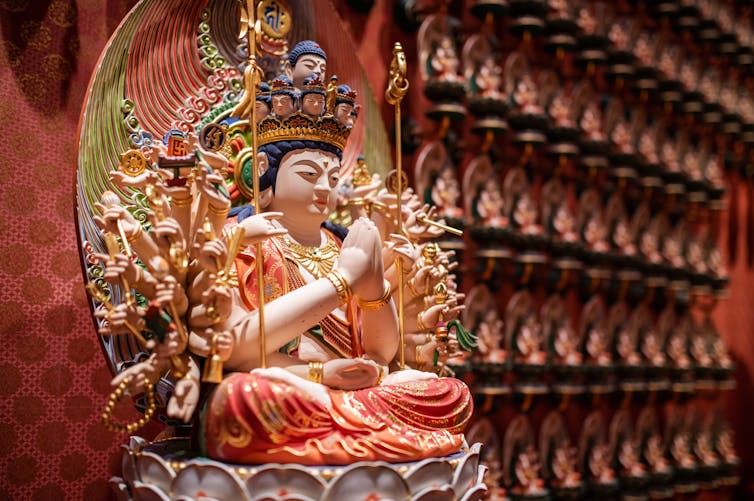
Boddhisatva Avalokiteล›vara, considered to be a compassionate protector, is believed to regularly visit Earth. taikrixel/ via iStock Getty Images Plus

Pierce Salguero, Penn State

โ€œBodhisattvaโ€ is a key idea in Buddhism. The word is constructed from the Sanskrit root bodhi, meaning โ€œawakeningโ€ or โ€œenlightenment,โ€ and sattva, meaning โ€œbeing.โ€ The core meaning of the word is โ€œa being who is on the way to becoming enlightened.โ€

As I explain in my book โ€œBuddhism: A Guide to the 20 Most Important Buddhist Ideas for the Curious and Skeptical,โ€ the word bodhisattva is understood in divergent ways by different groups of Buddhists.

Who is a bodhisattva?

In Theravฤda Buddhism, which is most prevalent in Southeast Asia, the term is exclusively used to refer to Siddhartha Gautama, as the Buddha was known before he became enlightened. In this school of thought, the word bodhisattva can also refer to Gautama in one of his previous rebirths as he worked toward enlightenment through numerous lifetimes as animals, people or other types of beings.

According to legend, Gautama was born as the crown prince of a kingdom in far northeastern India, but he gave up his throne and all of his riches in order to pursue enlightenment. Eventually, he fulfilled his destiny and transitioned from a being who is on the way to becoming awakened to a fully enlightened person โ€“ in other words, a Buddha.

In Mahฤyฤna Buddhism, practiced widely in East and Central Asia, the term bodhisattva can be used in a similar way. However, this form of Buddhism says that there are many more than just one Buddha; indeed, the ultimate goal of all true believers of Mahฤyฤna is to become a Buddha themselves. Most serious followers of this path take the bodhisattva vow to become recognized as bodhisattvas.

Additionally, in Mahฤyฤna belief, there are certain highly evolved bodhisattvas who have been practicing Buddhism for so many lifetimes that they have become superhuman divine beings. These so-called โ€œcelestial bodhisattvasโ€ are said to have accrued immense merits and powers. However, they have intentionally chosen to delay becoming Buddhas in order to dedicate themselves to compassionately helping others.

Why do bodhisattvas matter?

Some of the most famous advanced bodhisattvas, such as Avalokiteล›vara, Kแนฃitigarbha, Maรฑjuล›rฤซ, Samantabhadra and Vajrapฤแน‡i, are regularly prayed to and given offerings. Texts and mantras associated with most of them are regularly chanted in temples around the world. Devotees hope that the bodhisattvas, in their infinite compassion, will hear these calls and respond by sending blessings of health, good fortune and happiness.

Buddhists believe that celestial bodhisattvas reside in heavenly realms called Pure Lands located in faraway dimensions of the cosmos. The bodhisattva Maitreya, for example, is said to currently live in the Tuแนฃita Heaven, where he is awaiting rebirth as the next Buddha of our world.

Because they can manifest in different bodies simultaneously, bodhisattvas can also appear on Earth disguised as humans, animals, or other types of beings. For example, Tibetan Buddhists believe that the Dalai Lama is a manifestation of the bodhisattva Avalokiteล›vara, called Chenrezig in Tibetan, who regularly comes to earth to spread his message of compassion among humanity.

Pierce Salguero, Associate Professor of Asian History & Religious Studies, Penn State

This article is republished from The Conversation under a Creative Commons license. Read the original article.

Karaniya Metta Sutta: The Discourse on Loving-kindness


This is what should be done by those who are skilled in goodness,
and have known the place of peace.
Let them be able and upright, very upright,
easy to speak to, gentle and humble;

content and unburdensome,
unbusied, living lightly,
alert, with senses calmed,
courteous, not fawning on families.

Let them not do the slightest thing
that others might blame with reason.
May they be happy and safe!
May all beings be happy!

Whatever living creatures there are
with not a one left outโ€”
frail or firm, long or large,
medium, small, tiny or round,

visible or invisible,
living far or near,
those born or to be born:
May all beings be happy!

Let none turn from another,
nor look down on anyone anywhere.
Though provoked or aggrieved,
let them not wish pain on each other.

Even as a mother would protect with her life
her child, her only child,
so too for all creatures
unfold a boundless heart.

With love for the whole world,
unfold a boundless heart.
Above, below, all round,
unconstricted, without enemy or foe.

When standing, walking, sitting,
or lying down while yet unweary,
keep this ever in mind;
for this, they say, is a holy abiding in this life.

Avoiding harmful views,
virtuous, accomplished in insight,
with sensual desire dispelled,
they never come back to a womb again.

MATTLR.COM

3AM Questions that cut back

Sales Funnel Template

The Sales Funnel Explained

Mysterious Me

Just another WordPress.com site

Computer Vision Embedded

Harnessing the Power of Computer Vision in Embedded Technology

Optimal Happiness

Maximize Your Happiness, Well-Being, & Life Satisfaction

The Mind Connectory

Your Journey to Personal Growth Starts Here

Welcome to Huwspace

Here to share views and discuss the latest perspective's on the world going to hell in a handcart!

YourMindWithin.com

Change Your Life By Changing Your Mind

The Secret Truth About

The Secret Truth About Lifestyle Changes Is The Secret To Success

Fox Reviews Rock

Rock & Metal Reviews That Hit Hard

infoblogger.com

daily reaserch base article

God

I am God

Being Fit Start Now

The website Being Fit Start Now focuses on helping women, particularly those over 40, achieve their health and fitness goals from the comfort of their homes. It provides a variety of resources, including at-home workout programs, weight loss tips, and nutritional guidance. The site offers specific fitness routines, such as yoga workouts, full-body exercises, and specialized routines for reducing belly fat, all designed for different age groups, especially women over 40 and 50. Additionally, it features dietary advice, supplement recommendations, and healthy recipes aimed at supporting weight loss and overall wellness.

The Delightfully Resentful Sketchbook of Gladys Ruby

Failed Artist in Her Twilight Spreading Misery One Sketch at a Time.

Fairy who leaves the spirit world for the sake of love.โค๏ธโค๏ธโค๏ธโค๏ธ

read the book of the love fairy,๐ŸŒท๐ŸŒท๐ŸŒท๐Ÿ’–๐Ÿ’–๐Ÿ’

Mastering My Thoughts

My mind is running a marathon, so I write to relax and release.

Gospel road 66

Seeking truth in times of miss information

Life...Take 2!

I hope that someone sees this page and decides not to give up.

Bachir Bastien

Practical advice for a happier, fuller, and more meaningful life

marketingonthe.net/

Digital Marketing Directory, Tools & Info To Help You Grow Your Business

RazzWorks

Keep on Going - Keep On Growing

2 - Slava Ukraini

Supporting Ukrainian

praktikotips

Wellness tips for healthy & happy living

Andrea, illustrator

Illustrations to make you smile, laugh and sometimes, think ๐Ÿ˜‰

Happy Hub

Health, Wellness and Happiness Hub and Blog.

delishbymich

Custom Cakes, Baking and Recipes

Herder of Swine

Investigation of Misery and Joy

Tiktalkies

Let us cherish, preserve and spread the gift of knowledge

The Secret Sandbox

What are the differences between men and women?

BluntPathway

Honest path to a peaceful life

Iโ€™m Working on It

A mom on a journey to enlightenment

Estoreknight.com

Best Products To Buy at affordable price

Jaye Marie and Anita Dawes

two fiction writers

Design a site like this with WordPress.com
Get started