Iranian women have been rebelling against restrictions since the Islamic Revolution in 1979 – with renewed hope that protests this time will end differently

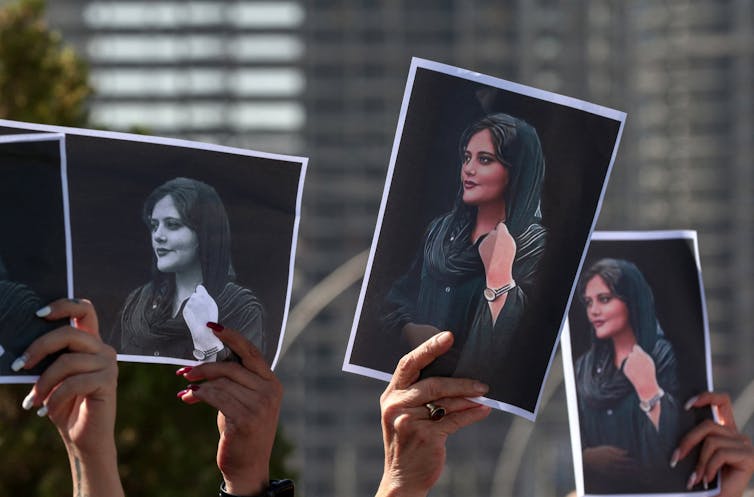
Women holding up photographs of 22-year-old Mahsa Amini during a demonstration in Arbil, the capital of Iraq’s autonomous Kurdistan region, on Sept. 24, 2022. Safin Hamed/AFP via Getty Images

Pardis Mahdavi, The University of Montana

Shouts of “death to the dictator” and “woman, life, freedom” are reverberating throughout the streets of Iran following the death of Mahsa Amini, a 22-year-old woman, while in custody of the “morality police” in Tehran.

These protests have echoes from past resistance movements. For the past two decades I have been studying gender and sexual politics in post-revolutionary Iran through on-the-ground ethnographic fieldwork. For some 40 years following the Feb. 11, 1979, Iranian Revolution, when Ayatollah Khomeini came to power and overthrew the Shah of Iran, Mohammad Reza Pahlavi, people have been rising up against the brutality of the regime in both urban and rural areas.

Today, these protests have been gaining increased momentum and international attention, giving many Iranians inside and outside of Iran some glimmers of hope.

Islamists’ resistance to westernization

Support for the Revolution grew out of many Iranians’ desire to bring equality and democracy to Iran. They criticized the monarchy as being overly deferential to the United States and were frustrated with increasing gaps between rich and poor.

The Islamists were most critical of westernization, which they saw as violating Islamic tenets and leading Iranians morally astray. They vowed to return Iran to Iranians and to re-center Iranian culture.

To do so, the Islamist regime juxtaposed its rule with everything that it believed to be wrong about “the West.” At the top of the list of critiques was what the regime viewed as loose morals. These loose morals were exemplified in the consumption of alcohol and women’s wearing miniskirts and heavy makeup and flaunting their hair and curves of their bodies in public.

As Khomeini ushered in the Islamists to power, a new era of austerity was born. Khomeini replaced the shah’s brutal police squad, SAVAK, with an equally if not more brutal Revolutionary Guard and created a new unit referred to as the “morality police.”

This era is perhaps best exemplified in the Khomeini quote that was painted across buildings and billboards in Tehran: “The Islamic Republic is not about fun, it is about morality. There is no fun to be had in the Islamic Republic of Iran.”

Controlling women’s fertility

Alongside the changes at home, Khomeini also engaged the country in a decadelong war with its neighbor Iraq.

Worried about the rising death toll coming out of the Iranian Revolution, combined with increasing numbers of soldiers needed for the Iran-Iraq war, the Islamists realized that they would need to increase their population quickly, according to demographic researchers. Thus, in the 1980s Khomeini instituted a series of policies in Iran to encourage families to have more children.

As a result, the birth rate in Iran in the 1980s swelled to an average of 3.5 children per family, up 30% from the prior decade.

A decade later, the Islamists realized that the population boom would need government support. Infrastructure would have to be strengthened and jobs created. The government did a complete turnaround and replaced its policy with family planning messages broadcast on the radio and television encouraging families to have fewer children. Sex education courses and free family planning resources were required for all couples who wished to be married. By 1994 the number of women using family planning was up 30% from 1989.

When the new millennium was ushered in, fully two-thirds of the country’s population was under the age of 21. These young people were born into the Islamic Republic of Iran that Khomeini and the Islamists had created: Women were told to wear long black cloaks from head to toe, covering every inch and curve of their bodies; the most brutal people were members of the morality police, watching every move and any strands of hair that escaped covering. If young people were found holding hands, attending a party or reading a book, they were deemed immoral by the whims of a mercurial regime.

This generation had never known the supposed opulence of the monarchy. And as its members became more frustrated and more educated, the critiques of Iran’s past drilled into them by the Islamists made less sense.

Challenging the morality police

Mohammad Khatami, who took over as president in August 1997, sought to harmonize Islamic rule with the needs of a changing population and a modernizing world.

Young people, who formed the majority of the population, had found their voice. They began challenging the morality police by pushing their headscarves back millimeter by millimeter, holding hands in public and organizing spontaneous street gatherings.

Between 2000 and 2007, I conducted ethnographic fieldwork in the cities of Tehran, Shiraz, Esfahan and Mashad, following what young people referred to as Iran’s Sexual Revolution. The resisters demanded a more democratic regime focused on solving issues like unemployment and infrastructure challenges rather than on policing their bodies. During my research in Iran on sexual and social movements, I also had several run-ins with the morality police and experienced their brutality firsthand.

These young people’s revolution was fought through the language of morality using their bodies, their choices in outerwear, makeup and hairstyles. They defied the morality police by sliding their headscarves back, wearing layers of makeup and eye-catching outerwear, dancing in the streets and holding hands or kissing in public.

The government responded by cracking down and tightening its grip on the moral behavior of young people. Increased raids and public floggings were meant to send a strong message. But young people persisted in their resistance.

In 2005, when conservative candidate Mahmoud Ahmadinejad was elected president, the sexual revolution came under heightened threat.

Unlike his predecessor, Ahmadinejad had no interest in finding ways to work with the growing youth population of Iran or in more progressive interpretations of Islam. He ordered the morality police to crack down on young people, raiding homes and parties and arresting women on the streets who dared to violate Islamist rules. Public floggings increased, as did arrests of scholars, feminists and journalists. The conservatives wanted to send a message.

The emboldened young revolutionaries continued pushing for change. These movements came to a head in 2009 when, despite not receiving the popular vote, Ahmadinejad was reelected as president.

Led by the same young people who resisted the morality police during the sexual revolution, a new movement was born in the immediate aftermath of the 2009 elections. This was called the “Sabze,” or Green Movement. People took to the streets of Iran chanting “where is my vote?” and “not my president.”
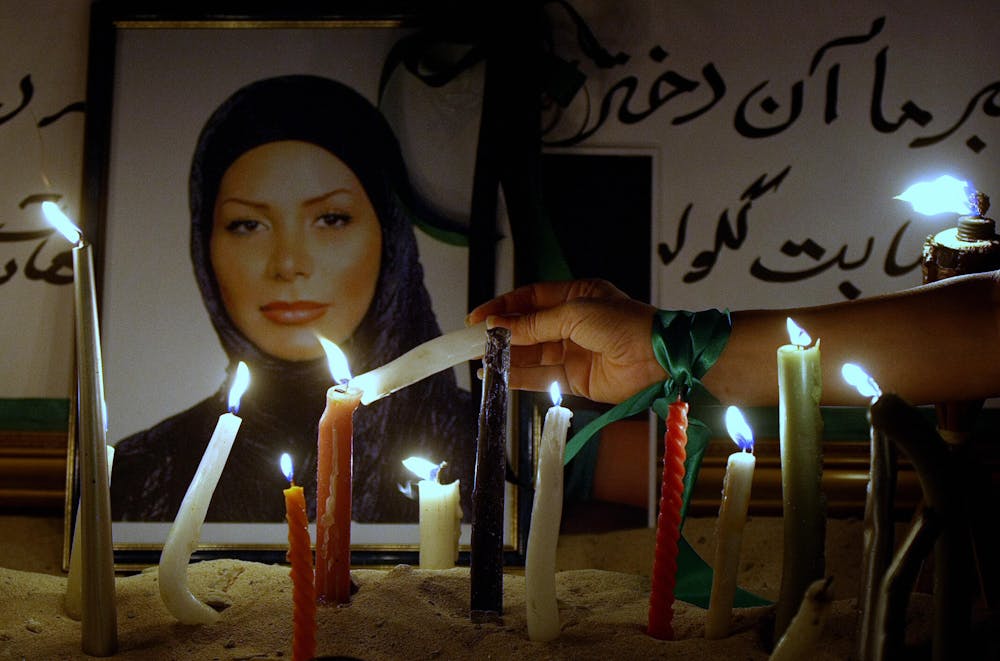
Candles lit before the photograph of a young woman in a headscarf.
An Iranian sporting a green ribbon on her arm lights a candle in front of a picture of Neda Agha-Soltan, a young Iranian woman who was killed in 2009. Marwan Naamani/AFP via Getty Images

A catalyzing moment for this movement was the chilling murder of Neda Agha-Soltan. She was killed in June 2009 simply for being at one of demonstrations where one of the bloodiest clashes between protesters, the Revolutionary Guard and the morality police took place. Her death was captured on film and shared with the world.

On the 40th anniversary of the Iranian Revolution in 2019, the streets of Iran were once again filled with resisters, many of whom had participated in street protests since the early 2000s. These same children of the revolution and Iran-Iraq war organized efforts such as #MyStealthyFreedom that featured women photographing themselves without headscarves in public in Iran and joining the global #MeToo movement.

Demanding accountability

By 2019 disenchantment with the regime had spread from the highly educated young people in the urban centers to even many of the most religiously devout families in some rural areas who had been previous supporters of the regime.

Iranians of all backgrounds facing rising oil prices and unemployment as a result of years of sanctions were increasingly losing faith in their government. Many no longer subscribed to the rhetoric about restoring moral order.

Today’s street protests are taking place in more than 50 cities throughout the country and have drawn the attention and support of the international community. These protests are both a refrain of past protests as well as a renewal of courage and hope.

As in the past, since Sept. 16, 2022, activists are taking to the streets to challenge a regime steeped in a rhetoric of harshly interpreted morality rather than governing with the best intentions of the people. And as in the protests of 2009 and 2019, they are calling for accountability of the government’s shortcomings, as well as highlighting the poverty that rages throughout the country – along with the pain of the people.

Pardis Mahdavi, Provost and Executive Vice President, The University of Montana

This article is republished from The Conversation under a Creative Commons license. Read the original article.


Native Americans’ decadeslong struggle for control over sacred lands is making progress

Mauna Kea, a dormant volcano in Hawaii, with an observatory visible on its summit. Native Hawaiians consider the mountain sacred and object to construction on it. Chris Condon/PGA TOUR via Getty Images

Rosalyn R. LaPier, University of Illinois at Urbana-Champaign

Who should manage public land that is sacred to Native Americans?

That is the question that the United States government and some states hope recent policy changes will address by giving Indigenous people greater input into managing such land. Co-management, as the policy is called, might alleviate the friction that emerges when sacred landscapes are managed without Native American input.

Mauna Kea, a 13,802-foot dormant volcano on the island of Hawaii, is one example. The mountain is managed as public land by the state of Hawaii. Native Hawaiians have protested the state’s management of Mauna Kea for decades, saying Hawaii has allowed too many research buildings on their sacred mountain, which disrupts their ability to practice their religion.

This kind of conflict is not unique to Hawaii. Indigenous peoples have lived in what is now the United States for thousands of years and developed intimate relationships with the lands they call home. For years, Native people across the country have demanded more input into how the government manages areas they consider sacred.

Now, the government may finally be listening.

‘We worship there’

As a Native American scholar of religion and the environment, I am interested in Indigenous peoples’ relationship to the natural world and their struggle to protect their sacred landscapes.

Native Hawaiians believe that Mauna Kea is the first creation of the Earth Mother, Papahānaumoku, and the Sky Father, Wākea. The mountain is an important part of their origin narrative.

For astronomers, the mountain has another significance. They believe the summit of Mauna Kea has the clearest skies for conducting research. For the past 50 years, the state of Hawaii has leased the summit of the mountain to dozens of research institutions. Together, they have built 13 telescopes and numerous buildings on Mauna Kea.

Three telescopes on a mountain top, sitting above the clouds
The Subaru, Keck I and Keck II Telescopes at the Mauna Kea Observatories. Julie Thurston Photography/Contributor via Getty Images

For years Native Hawaiian leaders have argued that the state ignored their concerns over such construction. When Mauna Kea was selected in 2009 as the preferred site for the Thirty Meter Telescope, a new class of extremely large telescope, Native Hawaiians protested to stop the project.

Native Hawaiians, like those from other Indigenous religious traditions, believe that sacred areas should be left alone without roads or buildings because they are the homes of the divine.

“We worship there, the iwis of our kupuna [bones of our elders] are buried there,” Mililani Trask, the Hawaii island’s trustee for the Office of Hawaiian Affairs, said at a public meeting regarding an environmental impact statement of Mauna Kea with the National Science Foundation on Aug. 9, 2022. “No,” she continued, “you will not build here.”

The state of Hawaii is hoping to address this ongoing conflict with the creation of a new eight-person commission that includes three Native Hawaiian leaders to manage Mauna Kea.

“I believe we can find a way for science and culture to coexist on Mauna Kea in a mutually beneficial way,” Hawaiian Gov. David Ige said on Sept. 12, 2022, when he announced the new commission.

What makes land sacred?

Native American religions, similar to other religions, view areas as sacred because they are the homes of gods or places that are sanctified by a god. Sacred places may be physically small or large areas, they may be built or natural areas, such as churches and shrines, or mountains and rivers.

Religious studies scholars such as Tisa Wenger have argued that religious freedom for Native Americans has been difficult because “the U.S. government has often acted as if Indian traditions were somehow not truly religious and therefore not eligible for the constitutional protections of the First Amendment.”

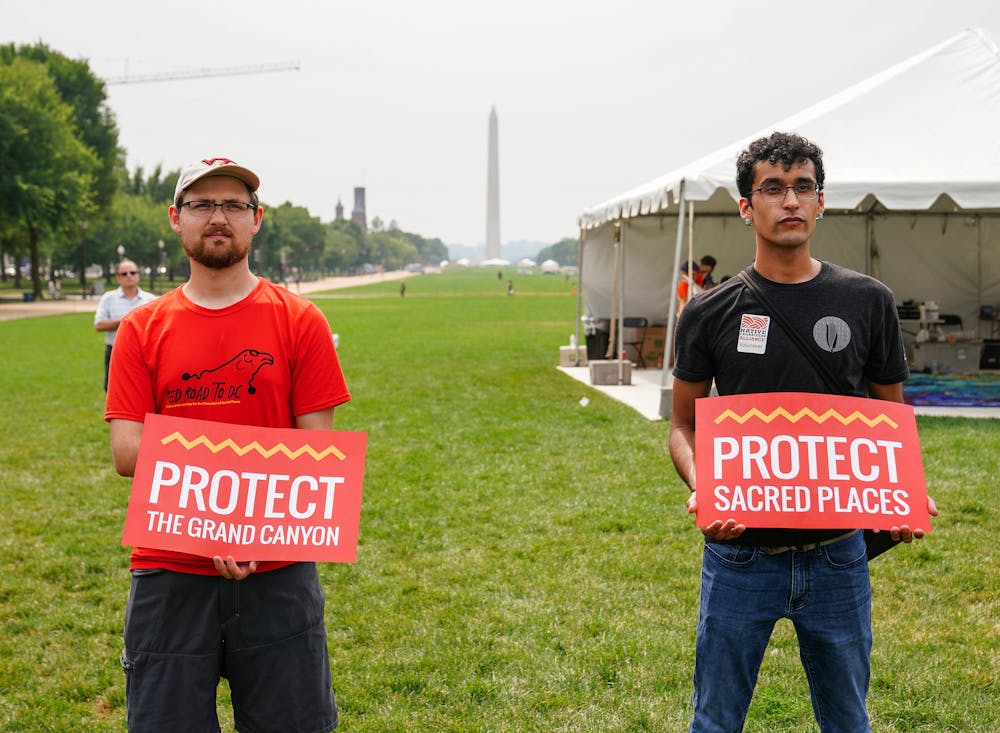
Two men stand with signs reading, 'Protect sacred places' on the National Mall, with the Washington Monumemt visible in the background.
People call for the protection of sacred Indigenous spaces to commemorate the delivery of a totem pole carved by the Lummi Nation as a gift to President Joe Biden on July 29, 2021, in Washington, D.C. Jemal Countess/Getty Images for Native Organizers Alliance

In one dispute in the 1980s, the U.S. Forest Service wanted to construct a road across a sacred mountain in Northern California. A consortium of tribes fought back, and the case ended in the Supreme Court; the tribes lost.

Following that decision, in 1996, President Bill Clinton created a definition of Native American sacred land as a “specific, discrete, narrowly delineated location on Federal land.”

This language intentionally excludes large areas such as mountains or open landscapes in favor of smaller sites. That does not fully represent the variety of places that Native peoples consider sacred, say religious studies scholars, leading to inevitable clashes over the meaning and uses of such lands.

Co-management is one small step

On Sept. 13, 2022, Secretary of Interior Deb Haaland released new federal guidelines to help address these long-standing conflicts.

This new policy, which focuses on publicly managed areas that Native Americans view as sacred or culturally important, will allow some tribes to share management responsibilities with federal agencies.

“By acknowledging and empowering Tribes as partners in co-stewardship of our country’s lands and waters, every American will benefit from strengthened management of our federal land and resources,” Haaland said.

In a related effort, Congress on Sept. 14 held hearings on two new bills to address this same issue. If they pass, their backers hope they will facilitate the inclusion of “tribal management of public lands” and strengthen the “protection of sacred and cultural sites.”

Such changes are “a small step, but an important one, in giving Tribal nations the respect and authority they deserve,” said Rep. Raúl M. Grijalva, a Democrat from Arizona.

But, he added of the federal government’s new desire to share land management with tribes, “There is no deed that can undo or fully compensate for this country’s historical neglect and desecration of Indigenous Peoples’ culture and places that are sacred to them.”

Rosalyn R. LaPier, Professor of HIstory, University of Illinois at Urbana-Champaign

This article is republished from The Conversation under a Creative Commons license. Read the original article.
Yom Kippur: What does Judaism actually say about forgiveness?

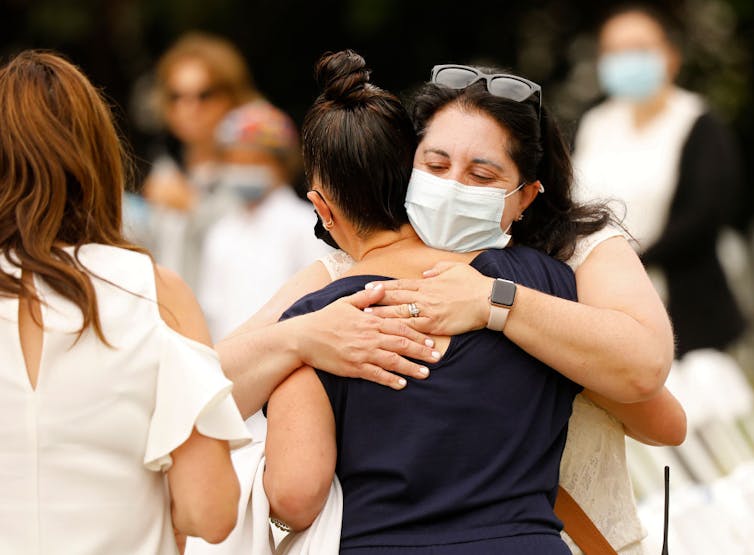
Two women embrace before a Yom Kippur service held outdoors during the COVID-19 pandemic in Los Angeles. Al Seib/Los Angeles Times via Getty Images

Adam B. Cohen, Arizona State University

The Jewish High Holidays include Rosh Hashana and Yom Kippur. Traditionally, Jews view the holidays as a chance to reflect on our shortcomings, make amends and seek forgiveness, both from other people and from the Almighty.

Jews pray and fast on Yom Kippur to demonstrate their remorse and to focus on reconciliation. According to Jewish tradition, it is at the end of this solemn period that God seals his decision about each person’s fate for the coming year. Congregations recite a prayer called the “Unetanah Tokef,” which recalls God’s power to decide “who shall live and who shall die, who shall reach the ends of his days and who shall not” – an ancient text that Leonard Cohen popularized with his song “Who by Fire.”

Forgiveness and related concepts, such as compassion, are central virtues in many religions. What’s more, research has shown that it is psychologically beneficial.

But each religious tradition has its own particular views about forgiveness, as well, including Judaism. As a psychologist of religion, I have done research on these similarities and differences when it comes to forgiveness.

Person to person

Several specific attitudes about forgiveness are reflected in the liturgy of the Jewish High Holidays, so those who go to services are likely to be aware of them – even if they skip out for a snack.

In Jewish theology, only the victim has the right to forgive an offense against another person, and an offender should repent toward the victim before forgiveness can take place. Someone who has hurt another person must sincerely apologize three times. If the victim still withholds forgiveness, the offender is considered forgiven, and the victim now shares the blame.

The 10-day period known as the “Days of Awe” – Rosh Hashana, Yom Kippur and the days between – is a popular time for forgiveness. Observant Jews reach out to friends and family they have wronged over the past year so that they can enter Yom Kippur services with a clean conscience and hope they have done all they can to mitigate God’s judgment.

The teaching that only a victim can forgive someone implies that God cannot forgive offenses between people until the relevant people have forgiven each other. It also means that some offenses, such as the Holocaust, can never be forgiven, because those martyred are dead and unable to forgive.

Many people dressed in black and white stand in a courtyard between ancient walls.
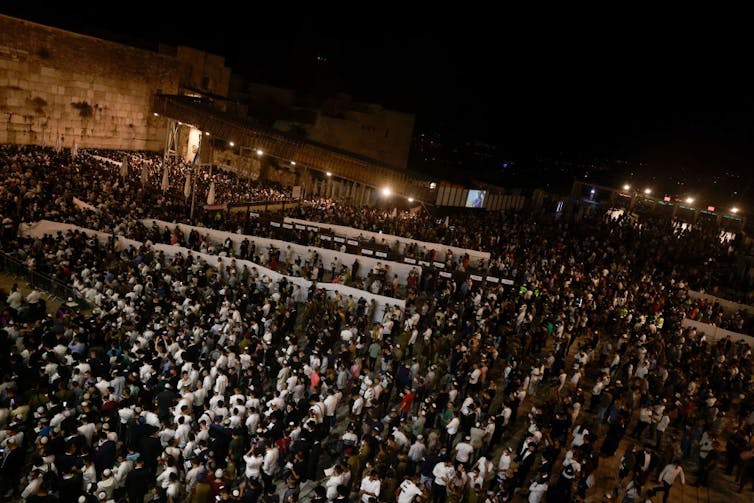
Thousands of Jewish pilgrims attend penitential prayers at the Western Wall in Jerusalem ahead of the Jewish High Holiday of Rosh Hashana. Menahem Kahana/AFP via Getty Images

To forgive or not to forgive?

In psychological research, I have found that most Jewish and Christian participants endorse the views of forgiveness espoused by their religions.

As in Judaism, most Christian teachings encourage people to ask and give forgiveness for harms done to one another. But they tend to teach that more sins should be forgiven – and can be, by God, because Jesus’ death atoned vicariously for people’s sins.

Even in Christianity, not all offenses are forgivable. The New Testament describes blaspheming against the Holy Spirit as an unforgivable sin. And Catholicism teaches that there is a category called “mortal sins,” which cut off sinners from God’s grace unless they repent.

One of my research papers, consisting of three studies, shows that a majority of Jewish participants believe that some offenses are too severe to forgive; that it doesn’t make sense to ask someone other than the victim about forgiveness; and that forgiveness is not offered unconditionally, but after the offender has tried to make things right.

Take this specific example: In one of my research studies I asked Jewish and Christian participants if they thought a Jew should forgive a dying Nazi soldier who requested forgiveness for killing Jews. This scenario is described in “The Sunflower” by Simon Wiesenthal, a writer and Holocaust survivor famous for his efforts to prosecute German war criminals.

A color photograph of an older, balding man in a blue shirt and striped tie.
Simon Wiesenthal at the White House during the Reagan administration. Diana Walker/The Chronicle Collection via Getty Images

Jewish participants often didn’t think the question made sense: How could someone else – someone living – forgive the murder of another person? The Christian participants, on the other hand, who were all Protestants, usually said to forgive. They agreed more often with statements like “Mr. Wiesenthal should have forgiven the SS soldier” and “Mr. Wiesenthal would have done the virtuous thing if he forgave the soldier.”

It’s not just about the Holocaust. We also asked about a more everyday scenario – imagining that a student plagiarized a paper that participants’ friends had written, and then asked the participants for forgiveness – and saw similar results.

Jewish people have a wide variety of opinions on these topics, though, as they do in all things. “Two Jews, three opinions!” as the old saying goes. In other studies with my co-researchers, we showed that Holocaust survivors, as well as Jewish American college students born well after the Holocaust, vary widely in how tolerant they are of German people and products. Some are perfectly fine with traveling to Germany and having German friends, and others are unwilling to even listen to Beethoven.

In these studies, the key variable that seems to distinguish Jewish people who are OK with Germans and Germany from those who are not is to what extent they associate all Germans with Nazism. Among the Holocaust survivors, for example, survivors who had been born in Germany – and would have known German people before the war – were more tolerant than those whose first, perhaps only, exposure to Germans had been in the camps.

Forgiveness is good for you – or is it?

American society – where about 7 in 10 people identify as Christian – generally views forgiveness as a positive virtue. What’s more, research has found there are emotional and physical benefits to letting go of grudges.

But does this mean forgiveness is always the answer? To me, it’s an open question.

For example, future research could explore whether forgiveness is always psychologically beneficial, or only when it aligns with the would-be forgiver’s religious views.

If you are observing Yom Kippur, remember that – as with every topic – Judaism has a wide and, well, forgiving view of what is acceptable when it comes to forgiveness.

Adam B. Cohen, Professor of Psychology, Arizona State University

This article is republished from The Conversation under a Creative Commons license. Read the original article.
What is a bodhisattva? A scholar of Buddhism explains

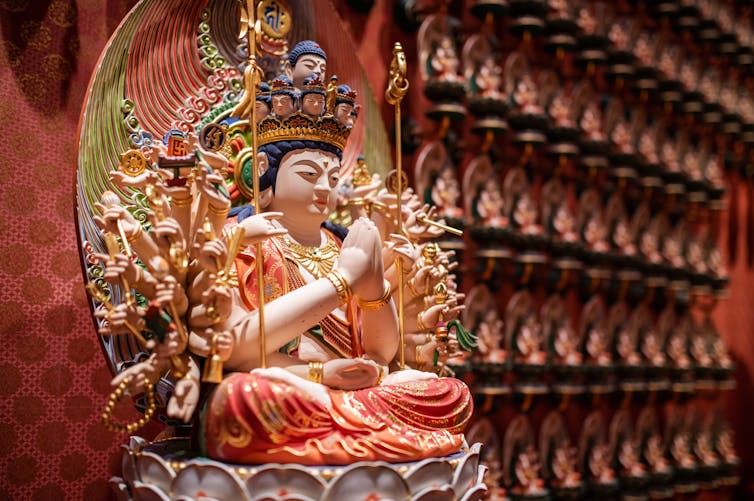
Boddhisatva Avalokiteśvara, considered to be a compassionate protector, is believed to regularly visit Earth. taikrixel/ via iStock Getty Images Plus

Pierce Salguero, Penn State

“Bodhisattva” is a key idea in Buddhism. The word is constructed from the Sanskrit root bodhi, meaning “awakening” or “enlightenment,” and sattva, meaning “being.” The core meaning of the word is “a being who is on the way to becoming enlightened.”

As I explain in my book “Buddhism: A Guide to the 20 Most Important Buddhist Ideas for the Curious and Skeptical,” the word bodhisattva is understood in divergent ways by different groups of Buddhists.

Who is a bodhisattva?

In Theravāda Buddhism, which is most prevalent in Southeast Asia, the term is exclusively used to refer to Siddhartha Gautama, as the Buddha was known before he became enlightened. In this school of thought, the word bodhisattva can also refer to Gautama in one of his previous rebirths as he worked toward enlightenment through numerous lifetimes as animals, people or other types of beings.

According to legend, Gautama was born as the crown prince of a kingdom in far northeastern India, but he gave up his throne and all of his riches in order to pursue enlightenment. Eventually, he fulfilled his destiny and transitioned from a being who is on the way to becoming awakened to a fully enlightened person – in other words, a Buddha.

In Mahāyāna Buddhism, practiced widely in East and Central Asia, the term bodhisattva can be used in a similar way. However, this form of Buddhism says that there are many more than just one Buddha; indeed, the ultimate goal of all true believers of Mahāyāna is to become a Buddha themselves. Most serious followers of this path take the bodhisattva vow to become recognized as bodhisattvas.

Additionally, in Mahāyāna belief, there are certain highly evolved bodhisattvas who have been practicing Buddhism for so many lifetimes that they have become superhuman divine beings. These so-called “celestial bodhisattvas” are said to have accrued immense merits and powers. However, they have intentionally chosen to delay becoming Buddhas in order to dedicate themselves to compassionately helping others.

Why do bodhisattvas matter?

Some of the most famous advanced bodhisattvas, such as Avalokiteśvara, Kṣitigarbha, Mañjuśrī, Samantabhadra and Vajrapāṇi, are regularly prayed to and given offerings. Texts and mantras associated with most of them are regularly chanted in temples around the world. Devotees hope that the bodhisattvas, in their infinite compassion, will hear these calls and respond by sending blessings of health, good fortune and happiness.

Buddhists believe that celestial bodhisattvas reside in heavenly realms called Pure Lands located in faraway dimensions of the cosmos. The bodhisattva Maitreya, for example, is said to currently live in the Tuṣita Heaven, where he is awaiting rebirth as the next Buddha of our world.

Because they can manifest in different bodies simultaneously, bodhisattvas can also appear on Earth disguised as humans, animals, or other types of beings. For example, Tibetan Buddhists believe that the Dalai Lama is a manifestation of the bodhisattva Avalokiteśvara, called Chenrezig in Tibetan, who regularly comes to earth to spread his message of compassion among humanity.

Pierce Salguero, Associate Professor of Asian History & Religious Studies, Penn State

This article is republished from The Conversation under a Creative Commons license. Read the original article.
Evangelical college students often feel misunderstood – what helps boost understanding between students of all faiths?

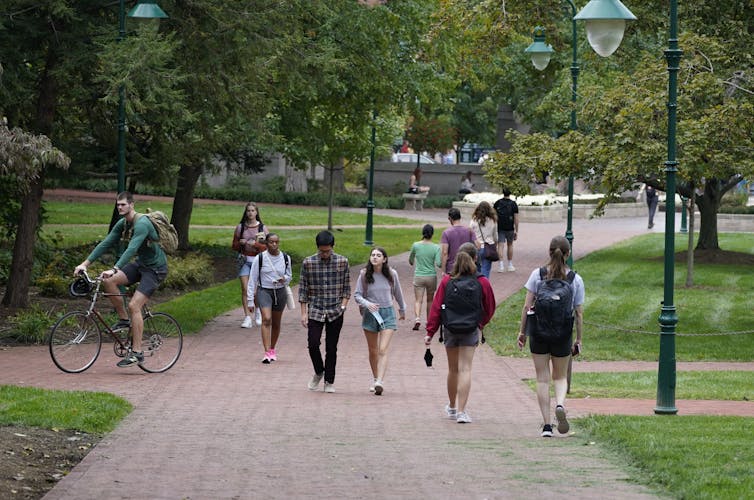
Do students’ views of people with different beliefs really change on campus? AP Photo/Darron Cummings

Matthew J. Mayhew, The Ohio State University; Christa Winkler, Mississippi State University, and Musbah Shaheen, The Ohio State University

Our research team has studied college students’ attitudes toward evangelicals, a topic that tends to prompt strong reactions.

Some liberals don’t see the topic as worthy of discussion – why study whether Americans appreciate a privileged group with strong influence on society? Meanwhile, many conservatives are adamant that evangelical perspectives are not tolerated, let alone welcome, on U.S. university campuses.

Yet our findings about students’ attitudes underscore important lessons about fostering tolerance and appreciation on campus for any group. Views of evangelicals are particularly interesting, since they highlight the complexities of social privilege: how individuals can feel discriminated against, even when their community as a whole is influential.

Surveying students

The Interfaith Diversity Experiences and Attitudes Longitudinal Survey, or IDEALS, surveyed 9,470 college students from 122 institutions across the country at three times: the beginning of their first year, the end of their first year, and the end of their senior year, which wrapped up in spring 2019. As part of this project, conducted by a team of researchers from Ohio State University, North Carolina University and the nonprofit Interfaith America, we asked students about their attitudes toward religious, spiritual and secular groups, including but not limited to atheists, Jews, Muslims and evangelicals.

We asked students to indicate their responses to four statements on a scale of 1, or “disagree strongly,” to 5, or “agree strongly”:

1) In general, people in this group make positive contributions to society.

2) In general, individuals in this group are ethical people.

3) I have things in common with people in this group.

4) In general, I have a positive attitude toward people in this group.

Our analysis controlled for other variables – such as the institution’s type, selectivity and size, and students’ race, gender, sexual orientation, major and political affiliation – to home in on the specific ways the campus learning environment was related to students’ views about different religious groups.

Compared with their attitudes toward other religious groups on campus, students’ appreciation for evangelicals grew at a slower pace, but still grew. On average, students’ responses showed an increase of over 40% in appreciation toward evangelicals by the end of their first year. By the time students graduated, they demonstrated another 30% increase between the end of their first year and fourth year of college.

Campus climate

After seeing that students’ views of evangelicals improved, on average, we wanted to better understand why.

First, we looked at the experiences students said were related to their gains, such as whether they took a religious studies course. Then, we conducted 18 case studies at institutions of various sizes and affiliations to learn about campus culture and hear from hundreds of students in focus groups. In these groups, we showed students data on the gains reported by their peers on campus and asked them why they thought these gains were made.

We found that appreciation increased for students on campuses they consider committed to inclusion for people of faiths, and people of no faith – regardless of whether the institutions were public or private, large or small, selective or not.

Some students talked about the impact of simply living and studying alongside people from different backgrounds. Many named the influence of interfaith and multifaith centers, spaces dedicated to bringing people from different religions together.

For example, a student at a Protestant-affiliated institution who identified as agnostic noted that she had “experienc[ed] a lot of toxic Christianity” growing up. She credited her interactions with a “progressive Christian” chaplain at her campus’s interfaith center with helping her understand that Christian beliefs and identities are diverse, and not limited to the type of faith she was introduced to as a child.

A crowd of students in a classroom, many of them with their hands up in worship, facing two singers at the front.
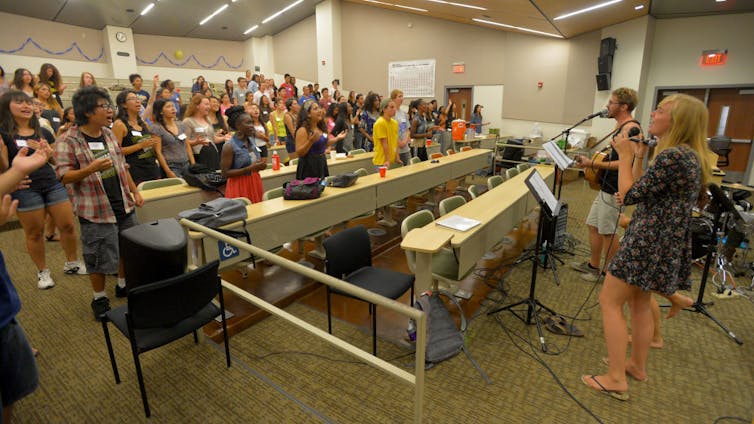
Members of a Christian group at California State University Long Beach worship in a lecture hall in 2014. Scott Varley/Digital First Media/Torrance Daily Breeze via Getty Images

Survey data also suggested that, on average, students whose views of evangelicals improved reported having at least two curricular experiences related to religion. This included many type of activities: for example, enrolling in a course specifically designed to enhance knowledge of different religious traditions; reflecting on one’s own religion in relationship to other perspectives as part of a class; and discussing other students’ religious or nonreligious backgrounds in class.

Personal relationships

How students related to one another was another important theme that often came up in discussions about views of evangelicals.

Evangelicals have to negotiate a seeming paradox: As Protestant Christians, who have long held influence in U.S. culture and politics, they belong to a privileged group. Yet many evangelical students say they feel unwelcome and misunderstood because of their beliefs.

Many non-Christian students who themselves feel marginalized because of their identities wrestle with how to make their evangelical peers aware of their relative privilege, and of how their beliefs and actions might affect other students.

For example, one student who identifies as atheist at a small, secular college recalled a Christmas tree put on their door by another student. “The person has literally no idea that that could possibly be upsetting,” they said, but added it was “a very sweet thing to do.” In other words, they believed that the other student was likely ignorant of why the Christmas tree could bother other students, but acting out of good intentions, tempering their anger about the unwelcome decoration.

Many students discussed developing empathy and humility. A Catholic student attending a Catholic college summarized, “Myself being a more liberal Christian, I’m not as accepting of the close-minded evangelical Christian … but that’s kind of being close-minded myself. … So I have to examine myself and be like, ‘I’m okay with them being them, even if I don’t agree with them.’ They’re saying, ‘All of these people are saying let’s accept everybody, but you’re not accepting me.’ And I said, ‘That’s absolutely right.’ … Even in political realms, too, I don’t agree with you, but I need to be okay with you.”

Finally, student gains in appreciation also seemed to stem from recognition that evangelicals are diverse, not one homogeneous group – as with the student who appreciated her conversations with the Christian chaplain at her campus’s interfaith center.

As a research team, we found this project’s findings left us considering ways to address deep divisions in the U.S. today. Some principles apply to fostering respect in many other situations beyond religion, and beyond college, from our offices at work to the halls of Congress: intentionally but empathetically engaging with one another’s differences.

Matthew J. Mayhew, Professor of Higher Education, The Ohio State University; Christa Winkler, Assistant Professor of Higher Education Leadership, Mississippi State University, and Musbah Shaheen, PhD student in Higher Education and Student Affairs, The Ohio State University

This article is republished from The Conversation under a Creative Commons license. Read the original article.

Prayer, Faith and His Will or Ours

p10104  I used to wonder why that sometimes it seemed GOD sometimes wouldn’t answer my prayers. I figured out he was answering them it was that some prayers he answered no to and others he answered in ways I didn’t understand at the time.  Then there were many prayers that were unanswered due to my lack of faith in him. God loves all of us regardless if we believe in him or not, Just like a father he loves his children both the good and bad. He helps all of us both by answering our prayers and by brining us experiences in our life to enrich us or teach us.

A friend of mine once stated like many others had done, If god exists and loves us then why would he allow famine, war and disease on earth. It is man who brings war and allows famine to be in this world. Mankind’s will is what spawns the majority of our sufferings. The problem is Man chooses his own will over that of God’s which pretty much says Man thinks he is the master instead of God. There are many who put God’s will before their own, yet its a very small amount of people compared to who that don’t. We are yet his children and even though we ignore his advice and will, He will still help us in times of need. But due to ignoring his advice and will we will have much more problems to face in our life.

  If a father tells his son, Son do not drink alcohol it will eventually consume you and your life and the son ignores the warning usually that son will have a very high chance of alcoholism and possibly the related health issues related to drinking. If the son heeds the fathers advice he avoids all the pitfalls of drinking. This is similar to what god has done, he has warned us in the bible of the pitfalls of both sin and putting our own will above his and most of us chose to ignore it. Though we will have to face many of the negative aspects of our choice to not follow God’s will he still loves us.

  Have faith in him and pray for his will to be done on earth as in heaven, Repent and ask for strength to resist the temptations of life.

God Bless

Ray Barbier

How You Use The Gifts

  p10006 Sometimes we seem to overlook the many blessings God has given us and we focus on the curses we brought upon our own selves. So many great gifts he has given to us every thing from life itself down to the power of freewill. We seem to get so caught up in the things we do not have and that which we want we forget how fortunate we are to have the things God has given us. Even things we like to give mankind and our own selves credit for is his works and his power that brought them to be within our life. Without God initially giving us life nothing would be possible at all. He gave mankind the ability to learn and to adapt to almost any situation that arises. He gave each one of us our own unique abilities and special qualities to help ourselves and those around us.

  Anything and everything mankind does is the result of Gods power and will manifested in the physical world. Yes, Even the evil things we do springs from the gifts he gave us. The gift of freewill is the gift that allows us to take all other gifts given to us and use them for the good of mankind and the world or for evil. The choice of how you use the gifts and abilities he granted each one of us is what freewill is all about. But along with freewill comes responsibility and the results of the choices made.

  Because of freewill we will be responsible for our actions and decisions we make in this lifetime god has granted us. To be honest there is not one of us that is righteous enough to enter the kingdom of heaven. The grace and the great gift of Jesus Christ is the saving grace for mankind. His blood washes our sins, But only the sins we truly regret and repent for.

  So the next time you feel down, depressed or just alone in the world think of all the gifts God has already given you and know there are many more awaiting you both here on earth and in heaven. Myself I rejoice in every morning I get to see and every night that comes afterward. Life may not be perfect and surely isn’t always a rose garden but it has its roses along with the thorns. I find a few thorns always makes me appreciate the roses of my life even more. One good thing is in life things always change if you wait long enough, So even the worst moments in life will pass if you keep faith and hope by your side.

Enough Rambling For Now
Peace.
R. Barbier

they were called Dragons and sea serpents


AN294   Being torn between science, religion and faith is the torment of the modern man. Science though sometimes factual is usually conjecture or unproven theories. So many times has the facts of science been overturn, proven inaccurate or were just plain wrong. Darwin’s theory of evolution has gaps and flawed facts and I do believe creatures evolve to some extent since there is proof out there living today, I don’t think man had came from apes. Yes Genetically we are cousins to the apes and that does not destroy my belief in Eden and the creation story.

   I don’t see why god wouldn’t create lower forms that are similar to man for us to study and learn from when science would appear. Also the Big Bang is another theory that does not conflict far as I am concerned with the biblical creation story. Now dinosaurs have been a thorn in Christians sides for a while but if one looks back across time there has been proof of dinosaurs existing during mankind’s existence though they were called Dragons and sea serpents.

Check out this video (playlist its a 6 part series) it will show you more on the dinosaur issue.


To view all 6 parts click this playlist link :   http://www.youtube.com/watch?v=FPt3Vv-l5dE&feature=PlayList&p=F476D63D65134D1F&playnext_from=PL&index=0&playnext=1

Well Enough Rambling for now.

Peace.

MATTLR.COM

3AM Questions that cut back

Sales Funnel Template

The Sales Funnel Explained

Mysterious Me

Just another WordPress.com site

Computer Vision Embedded

Harnessing the Power of Computer Vision in Embedded Technology

Optimal Happiness

Maximize Your Happiness, Well-Being, & Life Satisfaction

The Mind Connectory

Your Journey to Personal Growth Starts Here

Welcome to Huwspace

Here to share views and discuss the latest perspective's on the world going to hell in a handcart!

YourMindWithin.com

Change Your Life By Changing Your Mind

The Secret Truth About

The Secret Truth About Lifestyle Changes Is The Secret To Success

Fox Reviews Rock

Rock & Metal Reviews That Hit Hard

infoblogger.com

daily reaserch base article

God

I am God. I am God of Christianity, Islam, Judaism, Hinduism, Sikhism, Egyptian, Earth, World.

Being Fit Start Now

The website Being Fit Start Now focuses on helping women, particularly those over 40, achieve their health and fitness goals from the comfort of their homes. It provides a variety of resources, including at-home workout programs, weight loss tips, and nutritional guidance. The site offers specific fitness routines, such as yoga workouts, full-body exercises, and specialized routines for reducing belly fat, all designed for different age groups, especially women over 40 and 50. Additionally, it features dietary advice, supplement recommendations, and healthy recipes aimed at supporting weight loss and overall wellness.

The Delightfully Resentful Sketchbook of Gladys Ruby

Failed Artist in Her Twilight Spreading Misery One Sketch at a Time.

Fairy who leaves the spirit world for the sake of love.❤️❤️❤️❤️

read the book of the love fairy,🌷🌷🌷💖💖💝

Mastering My Thoughts

My mind is running a marathon, so I write to relax and release.

Gospel road 66

Seeking truth in times of miss information

Life...Take 2!

I hope that someone sees this page and decides not to give up.

Bachir Bastien

Practical advice for a happier, fuller, and more meaningful life

marketingonthe.net/

Digital Marketing Directory, Tools & Info To Help You Grow Your Business

RazzWorks

Keep on Going - Keep On Growing

Slava Ukraini

Supporting Ukrainian

praktikotips

Wellness tips for healthy & happy living

Andrea, illustrator

Illustrations to make you smile, laugh, and sometimes make you see things from a different perspective 😉

Happy Hub

Health, Wellness and Happiness Hub and Blog.

delishbymich

Custom Cakes, Baking and Recipes

Herder of Swine

Investigation of Misery and Joy

Tiktalkies

Let us cherish, preserve and spread the gift of knowledge

The Secret Sandbox

What are the differences between men and women?

BluntPathway

Honest path to a peaceful life

I’m Working on It

A mom on a journey to enlightenment

Estoreknight.com

Best Products To Buy at affordable price

Inner-voice

#truth #findingownself #quest #philosophy #contemplate

Design a site like this with WordPress.com
Get started