Buddhist philosophy has been around for thousands of years and has been used by many people to help them live happier and more fulfilling lives. In this blog post, we will explore some of the ways that Buddhist philosophy can be applied in modern society.
The main goal of both Buddhist psychology and philosophy is to eliminate suffering and unhappiness. All of us have a great deal of mental suffering and psychological problems because of emotional difficulties. We have many problems because of being irrational and out of touch with reality. But don’t worry! Buddhist philosophy can help you deal with reality – how we understand reality and how we deconstruct our fantasies and projections about reality.
One of the most important concepts in Buddhist philosophy is the Four Noble Truths. The first noble truth is that life is suffering. The second noble truth is that suffering is caused by craving and attachment. The third noble truth is that suffering can be overcome by eliminating craving and attachment. The fourth noble truth is that the way to eliminate craving and attachment is through the Eightfold Path.
Another important concept in Buddhist philosophy is mindfulness. Mindfulness is the practice of being present in the moment, without judgment or distraction. It involves paying attention to your thoughts, feelings, and sensations without trying to change them or react to them.
Compassion is another important concept in Buddhist philosophy. Compassion involves feeling empathy for others and wanting to help them. It involves recognizing that all beings suffer and that we are all interconnected.
Buddhism also teaches the importance of non-attachment. Non-attachment involves letting go of our attachment to material possessions, relationships, and other things that cause us suffering. It involves recognizing that everything is impermanent and that our attachment to things causes us to suffer.
In conclusion, Buddhist philosophy can be applied in many ways in modern society. It can help us eliminate suffering and unhappiness, deal with reality, achieve transcendence, develop a modern democratic society, create a socially and ecologically responsible economic system, practice mindfulness, feel compassion for others, and let go of our attachment to things.
So what are you waiting for? Start applying Buddhist philosophy in your life today! You won’t regret it!
I hope you find this blog post helpful. If you have any questions or comments, please let me know.
The ego is a tricky thing. It can make us feel good about ourselves, but it can also make us suffer. It can make us think we are better than others, but it can also make us feel insecure and inadequate. It can make us cling to things that don’t matter, but it can also make us miss out on things that do.
The ego is not who we really are. It is a false sense of self that we create based on our names, roles, beliefs, opinions, and experiences. It is what separates us from our true nature, which is pure awareness, bliss, and oneness with all existence.
So how can we overcome our ego and discover our true self? Here are some tips from Eastern philosophy and religion that can help us:
Meditate. Meditation is a way of quieting the mind and observing our thoughts and emotions without judgment or attachment. Meditation can help us realize that we are not our thoughts or feelings, but rather the awareness that witnesses them. Meditation can also help us dissolve the boundaries between ourselves and others, and experience a sense of interconnectedness and compassion.
Practice detachment. Detachment is not indifference or apathy, but rather a state of non-attachment to outcomes, results, or expectations. Detachment means accepting things as they are, without trying to control or manipulate them to fit our ego’s desires. Detachment can help us reduce stress, anxiety, and frustration, and cultivate peace, joy, and gratitude.
Cultivate humility. Humility is not self-deprecation or low self-esteem, but rather a recognition of our limitations and imperfections as human beings. Humility means acknowledging that we don’t know everything, that we make mistakes, and that we can learn from others. Humility can help us avoid arrogance, pride, and vanity, and foster openness, curiosity, and respect.
Embrace impermanence. Impermanence is the principle that everything in life is constantly changing and nothing lasts forever. Impermanence means accepting that our ego’s identity is not fixed or permanent, but rather fluid and dynamic. Impermanence can help us let go of clinging to the past or worrying about the future and live in the present moment.
Follow your dharma. Dharma is a Sanskrit word that means duty, purpose, or law. Dharma refers to the ethical and moral principles that guide our actions in accordance with our true nature. Dharma means following our inner voice and intuition, rather than our ego’s whims and fears. Dharma can help us find meaning, fulfillment, and happiness in life.
By following these tips, we can overcome our egos and align ourselves with our true selves. This can lead to a more authentic, harmonious, and enlightened way of living.
I hope you enjoyed this blog post. If you have any comments or questions, please feel free to share them below.
I don’t know, it may just be me but this recent trend in the USA of book banning seems to be censorship, it also seems to be motivated by some people’s prejudices and hatred of certain groups in society. The one that really gets me is the banning of books with the words butt and fart in them. That sounds so much like a South Park episode in which parents tried to ban a cartoon that featured the exact same thing. I guess it is all about one’s point of view there.
It is truly sad that in the land of the free that a few can decide what the many can see, read or do. Censorship is a dangerous thing, first people may censor things that may not be as important to you but then in time they censor more and more till there is only one view available in literature, and news, and allowed in public. It’s a dangerous slope to be walking along here people. Once you start down that road it sets you up for total censorship.
It seems like the right to pursue one’s happiness is only a right if it agrees with the beliefs and values of the most vocal group. You are only allowed to be happy if it is what others dictate as acceptable. I wonder if that is how the founding fathers saw it? I wonder if they wanted only a small group to be happy and the rest of the country to just fall in line and suffer or be denied their happiness.
I doubt they wanted it to be the pursuit of happiness if it is dictated by a single group or person. Does not matter if you like or believe in the way another individual seeks out happiness, that is their choice and life. I do however believe it is your right to speak your mind on the issue but not in a hateful or hurtful manner. If someone else dislikes your choice of how to seek happiness, you too must respect their opinion and not be angry or hateful in return.
Then we come around to the issue at hand, the fear of parents about their children being influenced by others. This has always been an issue, not just now and not just with the current issues being fought over. In the past, it was such things as religion in schools, desegregation, sex education, and so on. First off if you teach your children well at home about the things you fear, then those children should be well-armed to deal with the influences found in school and from peers.
Schools have been saddled with too much responsibility in trying to teach children social values. It is a hard balancing act and making sure the classrooms are inclusive and safe for all children regardless of their differences is not an easy task. Trying to teach children tolerance and respect for all people, regardless of their religion, color, sexual preference, and so on, should not be on the teacher’s shoulders but it should be the responsibility of the parents. The sad part is it seems there is a failure in that regard both in school and at home for some kids.
Jesus forgave and accepted all sinners, he taught forgiveness not judgmentalism. God is the judge, so we should leave the judging to him, we should instead love and forgive as we were taught by Jesus. To accept a sinner and love him/her is not accepting their sins. We all sin, and no sin is greater or lesser than another, and all is forgivable except one and that is blasphemy of the holy ghost/spirit. So why do we hate certain groups because of a certain sin, if we are to hate sinners then we must hate everyone including ourselves.
If you hate others, then you deny yourself the chance to know them, to understand them, and even the chance to be friends with them. Just because they live in a way you dislike or don’t understand doesn’t mean that they are not a good person. They are just different from you in that particular way. Look beyond your differences, put aside the things you see as unacceptable in each other, and look at the person in front of you and see them as who they really are.
I guess it boils down to this, you shouldn’t try to impose the values and morals of the religion you chose to follow on others. You should only apply those values and beliefs to yourself. It was your choice to believe in and follow the religion you chose and thus you must apply those values to yourself. Other people have chosen other paths in life and they are responsible for their own choices and actions. This does not mean you can not preach or try to counsel or advise. Just means you should accept it if they choose to do differently.
Love all people, regardless of their differences and shortcomings. Be a messenger of love and compassion not the harbinger of hate. and do your best to be a teacher or a preacher and not a persecutor. In the end, the choice is all yours, you can walk your path in the manner you chose and treat others the way you see fit. Just remember you are accountable for how you treat others in life and that you will reap the fruit of the seeds you have sewn in your life.
I wish everyone a happy life and love-filled days along this path of life.
Buddha said, “Hatred does not cease by hatred, but only by love; this is the eternal rule”. Love is the energy behind what we call forgiveness, and is one of the most important keys to ridding ourselves of hatred and anger. The Qur’an has the verse “The repayment of a bad action is one equivalent to it. But if someone pardons and puts things right, his reward is with Allah… (Qur’an, 42:40)”. Forgiveness is found in almost every great religious text. In the new testament of the Christian bible “Bear with each other and forgive whatever grievances you may have against one another. Forgive as the Lord forgave you. (Colossians 3:13, NIV)“
It seems that forgiveness is something important in religion, but it is also important to philosophers, poets, and great thinkers throughout history. The following are just some of what has been said/written about the subject of forgiveness.
Confucius ~“Those who cannot forgive others break the bridge over which they themselves must pass.”
Voltaire ~“We are all full of weakness and errors; let us mutually pardon each other our follies – it is the first law of nature.”
Paramhansa Yogananda ~ “Today I forgive all those who have ever offended me. I give my love to all thirsty hearts, both to those who love me and to those who do not love me.”
Epictetus ~“When you are offended at any man’s fault, turn to yourself and study your own failings. Then you will forget your anger.”
Friedrich Nietzsche ~ “And if your friend does evil to you, say to him, ”I forgive you for what you did to me, but how can I forgive you for what you did to yourself?”
Horace ~ “It is right for him who asks forgiveness for his offenses to grant it to others.”
So forgiveness is something important, it is the key to freeing yourself and others from past mistakes and all the pain and suffering those mistakes have caused. It is just as important to the forgiven as it is to the forgiver. Forgiveness may not always be easy, but in the end, it is well worth the effort. Holding on to a grudge, all the pain and suffering attached to it does no good for either side in the long run.
Living in a world that is full of fear, politics, and hate, Living and wishing that we all would choose a better fate, Wanting to see a change towards compassion before it is too late. They hate someone who is of another color and race, and they despise those who don’t belong to their political base. They create reasons to hate each other at an exponential pace. Love tries to break through all the hate and light the way, respect is what we need in all we do and say, Hope keeps us moving forward toward a better day.
Question why you hate and ask why you fear, Question all that you see and verify all that you hear, Question everything and think for yourself if you hold life and this world dear. Be true to yourself and be fair to all, don’t let fear or anger lead you to fall, and be ready to share compassion and answer love’s call. No one is above and no one is below, we are the same in the cosmic flow, and we all have a part to play in this cosmic show.
Our color or race matters not, our sex or preference matters not, we are all human and this is the only life we got. Right or Left matters none, we as a species are one, how we live and treat each other is what matters when it’s all said and done. Fear just divides and keeps one distracted and lost, hate destroys those who embrace it and has a heavy cost.
Acceptence, tolerance, and compassion are the keys to being forward-moving, Love is the fuel for our hearts to keep on grooving. Respect is the foundation we must build on, Life is what we must cherish before it is gone. We all are human and need to see that is true, working as one and doing for others is what we all need to do. If you choose to love or you choose to hate and fear it is all up to you.
“Bodhisattva” is a key idea in Buddhism. The word is constructed from the Sanskrit root bodhi, meaning “awakening” or “enlightenment,” and sattva, meaning “being.” The core meaning of the word is “a being who is on the way to becoming enlightened.”
In Theravāda Buddhism, which is most prevalent in Southeast Asia, the term is exclusively used to refer to Siddhartha Gautama, as the Buddha was known before he became enlightened. In this school of thought, the word bodhisattva can also refer to Gautama in one of his previous rebirths as he worked toward enlightenment through numerous lifetimes as animals, people or other types of beings.
According to legend, Gautama was born as the crown prince of a kingdom in far northeastern India, but he gave up his throne and all of his riches in order to pursue enlightenment. Eventually, he fulfilled his destiny and transitioned from a being who is on the way to becoming awakened to a fully enlightened person – in other words, a Buddha.
In Mahāyāna Buddhism, practiced widely in East and Central Asia, the term bodhisattva can be used in a similar way. However, this form of Buddhism says that there are many more than just one Buddha; indeed, the ultimate goal of all true believers of Mahāyāna is to become a Buddha themselves. Most serious followers of this path take the bodhisattva vow to become recognized as bodhisattvas.
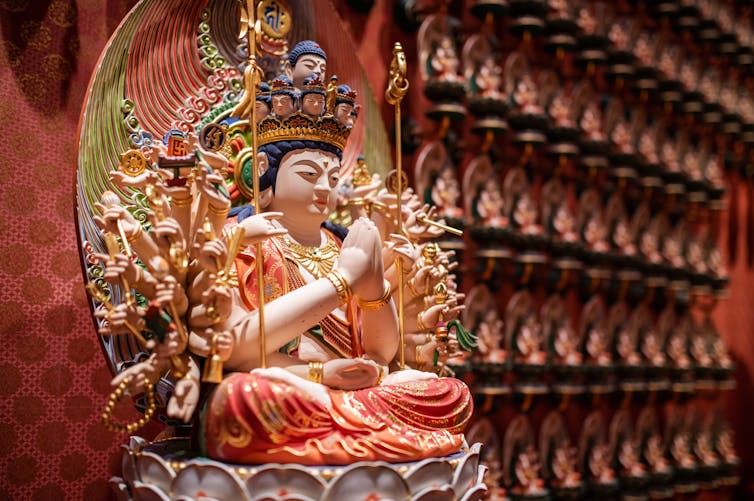
Additionally, in Mahāyāna belief, there are certain highly evolved bodhisattvas who have been practicing Buddhism for so many lifetimes that they have become superhuman divine beings. These so-called “celestial bodhisattvas” are said to have accrued immense merits and powers. However, they have intentionally chosen to delay becoming Buddhas in order to dedicate themselves to compassionately helping others.
Why do bodhisattvas matter?
Some of the most famous advanced bodhisattvas, such as Avalokiteśvara, Kṣitigarbha, Mañjuśrī, Samantabhadra and Vajrapāṇi, are regularly prayed to and given offerings. Texts and mantras associated with most of them are regularly chanted in temples around the world. Devotees hope that the bodhisattvas, in their infinite compassion, will hear these calls and respond by sending blessings of health, good fortune and happiness.
Buddhists believe that celestial bodhisattvas reside in heavenly realms called Pure Lands located in faraway dimensions of the cosmos. The bodhisattva Maitreya, for example, is said to currently live in the Tuṣita Heaven, where he is awaiting rebirth as the next Buddha of our world.
Because they can manifest in different bodies simultaneously, bodhisattvas can also appear on Earth disguised as humans, animals, or other types of beings. For example, Tibetan Buddhists believe that the Dalai Lama is a manifestation of the bodhisattva Avalokiteśvara, called Chenrezig in Tibetan, who regularly comes to earth to spread his message of compassion among humanity.
Some liberals don’t see the topic as worthy of discussion – why study whether Americans appreciate a privileged group with strong influence on society? Meanwhile, many conservatives are adamant that evangelical perspectives are not tolerated, let alone welcome, on U.S. university campuses.
Yet our findings about students’ attitudes underscore important lessons about fostering tolerance and appreciation on campus for any group. Views of evangelicals are particularly interesting, since they highlight the complexities of social privilege: how individuals can feel discriminated against, even when their community as a whole is influential.
Surveying students
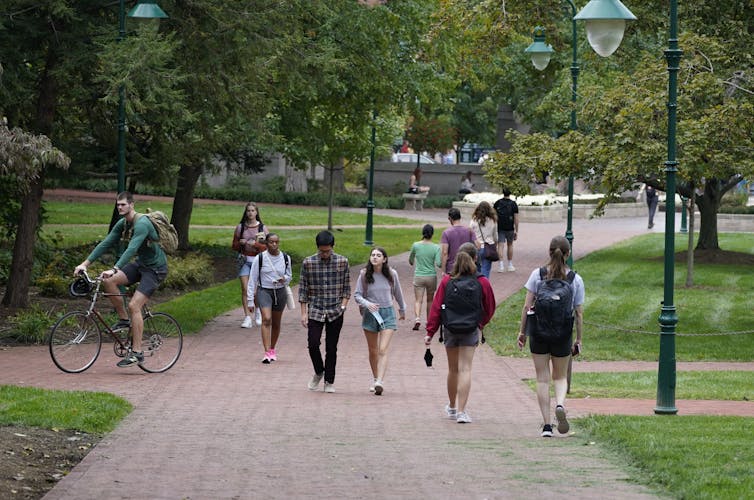
The Interfaith Diversity Experiences and Attitudes Longitudinal Survey, or IDEALS, surveyed 9,470 college students from 122 institutions across the country at three times: the beginning of their first year, the end of their first year, and the end of their senior year, which wrapped up in spring 2019. As part of this project, conducted by a team of researchers from Ohio State University, North Carolina University and the nonprofit Interfaith America, we asked students about their attitudes toward religious, spiritual and secular groups, including but not limited to atheists, Jews, Muslims and evangelicals.
We asked students to indicate their responses to four statements on a scale of 1, or “disagree strongly,” to 5, or “agree strongly”:
1) In general, people in this group make positive contributions to society.
2) In general, individuals in this group are ethical people.
3) I have things in common with people in this group.
4) In general, I have a positive attitude toward people in this group.
Our analysis controlled for other variables – such as the institution’s type, selectivity and size, and students’ race, gender, sexual orientation, major and political affiliation – to home in on the specific ways the campus learning environment was related to students’ views about different religious groups.
Compared with their attitudes toward other religious groups on campus, students’ appreciation for evangelicals grew at a slower pace, but still grew. On average, students’ responses showed an increase of over 40% in appreciation toward evangelicals by the end of their first year. By the time students graduated, they demonstrated another 30% increase between the end of their first year and fourth year of college.
Campus climate
After seeing that students’ views of evangelicals improved, on average, we wanted to better understand why.
First, we looked at the experiences students said were related to their gains, such as whether they took a religious studies course. Then, we conducted 18 case studies at institutions of various sizes and affiliations to learn about campus culture and hear from hundreds of students in focus groups. In these groups, we showed students data on the gains reported by their peers on campus and asked them why they thought these gains were made.
We found that appreciation increased for students on campuses they consider committed to inclusion for people of faiths, and people of no faith – regardless of whether the institutions were public or private, large or small, selective or not.
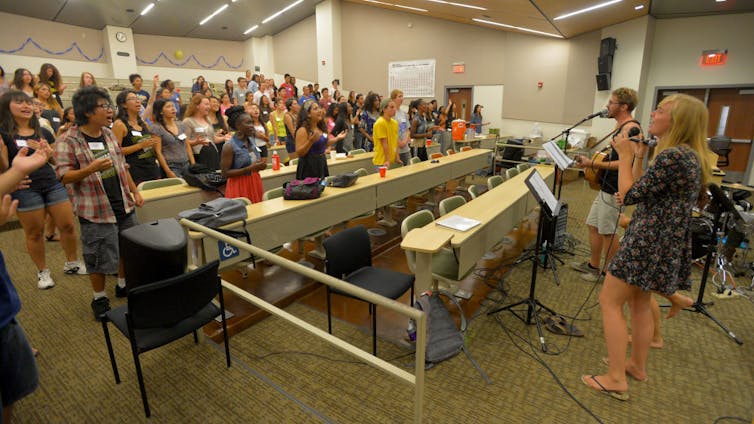
Some students talked about the impact of simply living and studying alongside people from different backgrounds. Many named the influence of interfaith and multifaith centers, spaces dedicated to bringing people from different religions together.
For example, a student at a Protestant-affiliated institution who identified as agnostic noted that she had “experienc[ed] a lot of toxic Christianity” growing up. She credited her interactions with a “progressive Christian” chaplain at her campus’s interfaith center with helping her understand that Christian beliefs and identities are diverse, and not limited to the type of faith she was introduced to as a child.
Survey data also suggested that, on average, students whose views of evangelicals improved reported having at least two curricular experiences related to religion. This included many type of activities: for example, enrolling in a course specifically designed to enhance knowledge of different religious traditions; reflecting on one’s own religion in relationship to other perspectives as part of a class; and discussing other students’ religious or nonreligious backgrounds in class.
Personal relationships
How students related to one another was another important theme that often came up in discussions about views of evangelicals.
Evangelicals have to negotiate a seeming paradox: As Protestant Christians, who have long held influence in U.S. culture and politics, they belong to a privileged group. Yet many evangelical students say they feel unwelcome and misunderstood because of their beliefs.
Many non-Christian students who themselves feel marginalized because of their identities wrestle with how to make their evangelical peers aware of their relative privilege, and of how their beliefs and actions might affect other students.
For example, one student who identifies as atheist at a small, secular college recalled a Christmas tree put on their door by another student. “The person has literally no idea that that could possibly be upsetting,” they said, but added it was “a very sweet thing to do.” In other words, they believed that the other student was likely ignorant of why the Christmas tree could bother other students, but acting out of good intentions, tempering their anger about the unwelcome decoration.
Many students discussed developing empathy and humility. A Catholic student attending a Catholic college summarized, “Myself being a more liberal Christian, I’m not as accepting of the close-minded evangelical Christian … but that’s kind of being close-minded myself. … So I have to examine myself and be like, ‘I’m okay with them being them, even if I don’t agree with them.’ They’re saying, ‘All of these people are saying let’s accept everybody, but you’re not accepting me.’ And I said, ‘That’s absolutely right.’ … Even in political realms, too, I don’t agree with you, but I need to be okay with you.”
Finally, student gains in appreciation also seemed to stem from recognition that evangelicals are diverse, not one homogeneous group – as with the student who appreciated her conversations with the Christian chaplain at her campus’s interfaith center.
As a research team, we found this project’s findings left us considering ways to address deep divisions in the U.S. today. Some principles apply to fostering respect in many other situations beyond religion, and beyond college, from our offices at work to the halls of Congress: intentionally but empathetically engaging with one another’s differences.
Scientists regularly study the ongoing degradation of Earth’s environment and track the changes wrought by a warming planet. Economists warn that intensifying disasters are harming people’s quality of life. And policymakers focus on crafting rules to diminish the health and environmental effects of humanity’s growing footprint.
What is the role of philosophers and people of faith in this bigger discussion around the environment and sustainability? Rita D. Sherma is co-chair of a research initiative aimed at bringing the beliefs of religion, spirituality, and ethics to the study of sustainability. Here she explains the core ideas behind “green spirituality,” how religion and environmental protection are closely intertwined and the role faith can play in restoring hope amid the drumbeat of discouraging environmental news.
What is green spirituality?
Green spirituality is an orientation to the divine, or supreme reality, that is grounded in our experience of life on planet Earth. It respects the miracle of life on this planet and recognizes our relationship with it. Such a spirituality can have God or the divine as the focus, or it can be oriented toward the Earth and its ecosystems for those outside of organized religion. It encourages a contemplative and harmonious relationship with the Earth.
Green spirituality seeks to harness the spiritual traditions of the world to energize the effort to restore planetary ecosystems and stop future harm. https://www.youtube.com/embed/d42L4hVJmrA?wmode=transparent&start=0 The rights of nature movement wants to give sacred rivers the same legal protections as people.
Why do spiritual and religious teachings belong as part of the global conversation on the environment?
First, 80% of the world’s population practices an established religion or a spiritual tradition that offers community, support, and resources for resilience.
Second, as I have written in my new book on religion and sustainability, better technology will help human communities restore ecosystems. More and better data, such as computations to forecast disasters, will also be helpful. But both are inadequate in the face of human denial and recalcitrance.
In my book, I write: “Planetary survival is now predicated upon the alignment of our notions of both human and ecological rights with our highest principles. As such, ways of knowing that are embedded in religion, philosophy, spiritual ethics, moral traditions, and a culture that values the community and the commons – as an essential resource for the transformation necessary for environmental regeneration and renewal – are indispensable.” In other words, people on Earth need to tap into the ways of thinking from these faith traditions to address the environmental crises we face now.
Can faith and religion help counter rising eco-anxiety?
Catastrophic wildfires across the planet, extreme weather patterns that destroy homes and histories, degraded soil, toxic air, unsafe water, and the desecrated beauty of places we have loved are causing climate trauma and eco-anxiety. For those who are acutely aware of the cliff edge on which we stand as a species and as a planetary community, the despair evoked by the magnitude of the disaster is almost unbearable.
Religions, faiths, and spiritual practices can help in unique ways. In this space, people can find community, peaceful practices of meditation, prayer, embodied sacred actions that include rituals and liturgies, and a ‘long view’ informed by the tragedies and triumphs faced by spiritual ancestors. Faith can provide hope and resilience in the midst of crises.
How do different faith traditions treat respect for nature?
Religions may disagree on many things, but each contains philosophical or theological orientations that can be interpreted and applied in ways that protect the Earth.
Some traditions such as Hindu, Yogic, Indigenous and others see the self as a microcosm of macrocosm, or a part of the greater whole. And, a profound sacred immanence, or integral divine presence, is woven through their philosophies. For these spiritual traditions, religious practice integrates trees, flowers, sacred groves, sanctified terrains, rivers, mountains and elements of the entire ecosphere into liturgical and personal practice.
Christian ecotheology focuses on stewardship and the ethics of Earth justice. A well-known Muslim ecotheologian speaks of the Earth as a mosque in reference to a saying (hadith) of the prophet – which renders the entire Earth as sacrosanct. Jewish ecological thinkers have envisaged the idea of “Shomrei Adamah” (Keepers of the Earth), which connects humanity and the Earth through divine love.
How are organized religions putting environmental protection into practice?
Many initiatives and conversations are happening among religions, and among interreligious leadership and international bodies – most importantly, the United Nations initiatives.
Some important conversations include the Interfaith Rainforest Initiative, which brings the dedication, impact, and moral authority of different faiths to restore the world’s rainforests and help empower the Indigenous peoples who view themselves as their protectors. Greenfaith is a global, multireligious climate and environmental movement. I also serve on the advisory board of the Yale Forum on Religion and Ecology, a pioneering international interreligious project at Yale University started by scholars Mary Evelyn Tucker and John Grim that ignited the academic field of religion and ecology as a global engaged force for the greening of religion.
How are environmental advocacy groups drawing in religion?
In 1985, the World Wildlife Fund established the U.K.-based Alliance of Religion and Conservation for developing partnerships with religious groups for collaborating on environmental protection. WWF’s Sacred Earth: Faiths for Conservation program collaborates with faith groups and religious communities who are committed to the view that the Earth is a sacred charge that demands the commitment of our care.
In November 2017, the U.N. “Environment Programme,” realizing the significance of religious communities as key actors, founded the Faith for Earth Initiative to engage with faith-based organizations as partners, at all levels, toward achieving the sustainable development goals and realizing the 2030 agenda. The initiative affirms that “Spiritual values drive individual behaviors for more than 80 percent of people.”
In fall 2020, the Parliament of the World’s Religions and the U.N. Environment Programme jointly published a book titled “Faith for Earth – A Call for Action,” which provides an overview of the diversity of religious principles and practices that support action for the protection of the Earth.
I ask myself each morning, Who am I and what am I here for? Each morning the answer either eludes me or the answer I come up with is so vague and transient that it really isn’t a true answer. The best I can figure out is that I am here to live, to learn, to love and share that which I have been blessed to have. So now I do not ask myself those questions anymore, I ask instead how am I going to contribute to this world today? am I going to make a positive effort or will I be a non productive part of this world today? The choice is mine, how I react and how I contribute to the world around me is my choice and can not be made by anyone but me.
How are you going to contribute to our world we live in and are you going to be a positive, neutral or negative force within the day of life?
Another year has past and one more year closer to growing old Another year gone and with it the world grows even more cold
Cold the world might be but that does not phase the love i feel The world grows more selfish and that is something that is real.
The light is growing dimmer each day as life slowly slips away from us all. The source of love still remains strong and we should answer its call.
God is the light that will never burn out and we are mere reflections of his undying love. His son came to teach us compassion and forgiveness with the gentleness of a dove.
Unfortunately mankind grows arrogant and their hearts are full of a very selfish pride. Greed and corruption rules over most and from the aftermath there may be nowhere to hide.
With age comes wisdom, experience and hind sight is always 20/20 as we all know. The piece of wisdom I try to share is to always let your love and compassion show.
Mistakes we may all make in the life we are granted and to learn from them is the key. Anger is quick to destroy the love and compassion that resides in both you and me.
If you take anything from all the things i write I hope it is to love one another both freely and unconditionally. For life is too short to hold grudges, place/carry blame for mistakes intentionally done or unintentionally.
Live life to the fullest and don’t allow fear to rule your world for it will only stop you from truly living life. Don’t hang on to regrets or anger for all that will do is fill your world with unneeded and undeserved strife.
The website Being Fit Start Now focuses on helping women, particularly those over 40, achieve their health and fitness goals from the comfort of their homes. It provides a variety of resources, including at-home workout programs, weight loss tips, and nutritional guidance. The site offers specific fitness routines, such as yoga workouts, full-body exercises, and specialized routines for reducing belly fat, all designed for different age groups, especially women over 40 and 50. Additionally, it features dietary advice, supplement recommendations, and healthy recipes aimed at supporting weight loss and overall wellness.






 Dovestar
You must be logged in to post a comment.