In the vast and intricate tapestry of human experience, certain individuals possess the uncanny ability to summon forth the shadows that dwell within us. These people, knowingly or unknowingly, seem to masterfully press the delicate buttons of our psyche, igniting our ire and dragging us into the depths of emotional turmoil. Their perpetual dissatisfaction acts as a beacon of misery, attempting to pull others into the abyss of their own discontent.
Within each of us reside demons, sometimes lurking in the recesses of our consciousness. These demons, manifestations of our fears, insecurities, and past traumas, can be exorcised and transformed through introspection and healing. Some of these inner demons are reflections of our lived experiences, mirroring the scars and wounds we carry. Others are born of external influences, not of our own making, yet they nestle within us, shaping our thoughts and behaviors.
Our thoughts, the silent architects of our reality, wield immense power. They can elevate us to the pinnacles of success or plunge us into the chasms of despair. Some thoughts possess the transformative potential to change the course of our lives, inspiring growth and enlightenment. Conversely, others can corrode our spirit from within, becoming the very chains that bind us. The dichotomy of thought reveals that while some musings remain mere fantasies, others materialize into the tangible fabric of our existence.
Amidst this complex interplay, there are those remarkable individuals who have the gift of drawing out the best within us. These people, with their innate ability to uplift and inspire, turn ordinary days into celebrations of life. Their boundless hope and joy radiate outward, spreading positivity and light to all who are fortunate enough to encounter them.
The paths we tread in life are varied and numerous. Some lead us into the inferno of despair, engulfing us in suffering. Others circle endlessly, trapping us in a cycle of stagnation. Yet, there are those rare and precious paths that guide us towards the celestial realms of fulfillment and contentment.
In this intricate dance of existence, we hold the power to choose the company we keep. We possess the strength to confront and overcome the demons within us. The thoughts we entertain and cultivate are within our control, shaping our destiny. Ultimately, we choose the path we follow, for it is within our agency to determine the trajectory of our lives.
The question thus arises: Which paths will we choose to walk? Which thoughts will we allow to take root in our minds? Which people will we invite into our lives? The answers lie in our choices, and through these choices, we craft the narrative of our existence.
Thought of the day:To learn from one’s past is wise, but to dwell in the past is folly. Embrace the present with a heart full of hope and a mind open to the boundless possibilities of the future. Live well, for it is your life, and you alone hold the pen that writes your story.
The Jewish High Holidays include Rosh Hashana and Yom Kippur. Traditionally, Jews view the holidays as a chance to reflect on our shortcomings, make amends and seek forgiveness, both from other people and from the Almighty.
Jews pray and fast on Yom Kippur to demonstrate their remorse and to focus on reconciliation. According to Jewish tradition, it is at the end of this solemn period that God seals his decision about each person’s fate for the coming year. Congregations recite a prayer called the “Unetanah Tokef,” which recalls God’s power to decide “who shall live and who shall die, who shall reach the ends of his days and who shall not” – an ancient text that Leonard Cohen popularized with his song “Who by Fire.”
Forgiveness and related concepts, such as compassion, are central virtues in many religions. What’s more, research has shown that it is psychologically beneficial.
But each religious tradition has its own particular views about forgiveness, as well, including Judaism. As a psychologist of religion, I have done research on these similarities and differences when it comes to forgiveness.
Person to person
Several specific attitudes about forgiveness are reflected in the liturgy of the Jewish High Holidays, so those who go to services are likely to be aware of them – even if they skip out for a snack.
In Jewish theology, only the victim has the right to forgive an offense against another person, and an offender should repent toward the victim before forgiveness can take place. Someone who has hurt another person must sincerely apologize three times. If the victim still withholds forgiveness, the offender is considered forgiven, and the victim now shares the blame.
The 10-day period known as the “Days of Awe” – Rosh Hashana, Yom Kippur and the days between – is a popular time for forgiveness. Observant Jews reach out to friends and family they have wronged over the past year so that they can enter Yom Kippur services with a clean conscience and hope they have done all they can to mitigate God’s judgment.
The teaching that only a victim can forgive someone implies that God cannot forgive offenses between people until the relevant people have forgiven each other. It also means that some offenses, such as the Holocaust, can never be forgiven, because those martyred are dead and unable to forgive.
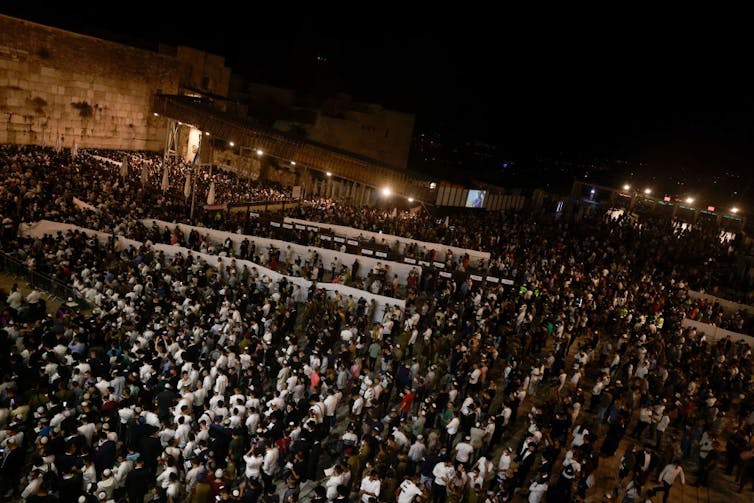
Thousands of Jewish pilgrims attend penitential prayers at the Western Wall in Jerusalem ahead of the Jewish High Holiday of Rosh Hashana. Menahem Kahana/AFP via Getty Images
To forgive or not to forgive?
In psychological research, I have found that most Jewish and Christian participants endorse the views of forgiveness espoused by their religions.
As in Judaism, most Christian teachings encourage people to ask and give forgiveness for harms done to one another. But they tend to teach that more sins should be forgiven – and can be, by God, because Jesus’ death atoned vicariously for people’s sins.
Even in Christianity, not all offenses are forgivable. The New Testament describes blaspheming against the Holy Spirit as an unforgivable sin. And Catholicism teaches that there is a category called “mortal sins,” which cut off sinners from God’s grace unless they repent.
One of my research papers, consisting of three studies, shows that a majority of Jewish participants believe that some offenses are too severe to forgive; that it doesn’t make sense to ask someone other than the victim about forgiveness; and that forgiveness is not offered unconditionally, but after the offender has tried to make things right.
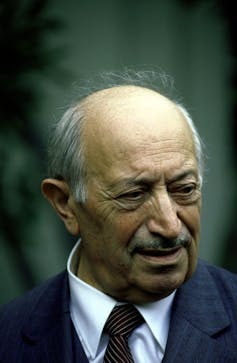
Take this specific example: In one of my research studies I asked Jewish and Christian participants if they thought a Jew should forgive a dying Nazi soldier who requested forgiveness for killing Jews. This scenario is described in “The Sunflower” by Simon Wiesenthal, a writer and Holocaust survivor famous for his efforts to prosecute German war criminals.
Jewish participants often didn’t think the question made sense: How could someone else – someone living – forgive the murder of another person? The Christian participants, on the other hand, who were all Protestants, usually said to forgive. They agreed more often with statements like “Mr. Wiesenthal should have forgiven the SS soldier” and “Mr. Wiesenthal would have done the virtuous thing if he forgave the soldier.”
It’s not just about the Holocaust. We also asked about a more everyday scenario – imagining that a student plagiarized a paper that participants’ friends had written, and then asked the participants for forgiveness – and saw similar results.
Jewish people have a wide variety of opinions on these topics, though, as they do in all things. “Two Jews, three opinions!” as the old saying goes. In other studies with my co-researchers, we showed that Holocaust survivors, as well as Jewish American college students born well after the Holocaust, vary widely in how tolerant they are of German people and products. Some are perfectly fine with traveling to Germany and having German friends, and others are unwilling to even listen to Beethoven.
In these studies, the key variable that seems to distinguish Jewish people who are OK with Germans and Germany from those who are not is to what extent they associate all Germans with Nazism. Among the Holocaust survivors, for example, survivors who had been born in Germany – and would have known German people before the war – were more tolerant than those whose first, perhaps only, exposure to Germans had been in the camps.
But does this mean forgiveness is always the answer? To me, it’s an open question.
For example, future research could explore whether forgiveness is always psychologically beneficial, or only when it aligns with the would-be forgiver’s religious views.
If you are observing Yom Kippur, remember that – as with every topic – Judaism has a wide and, well, forgiving view of what is acceptable when it comes to forgiveness.
Sometimes I just sit here and think about the evil things men have done in the name of God, for love, lust, greed and power. Then there is those that enjoy doing horrible things for pleasure, so much evil that is out there in the great big world. Then when I think there is no hope for us I remember all the great things people have done, the communities pulling together after a disaster, the people who dedicate their life to helping those in need of food, medicine and just a friend to care. Though the bad things we see seem to be more prominent in the world it isn’t so, they are the main things reported on in the media and recorded in history. Seems tragedy is a ratings booster and is good at grabbing someone’s interest more so than the good things that go on.
Unfortunately there are people who do horrible things, this has been a fact of life since the beginning of civilization if not humanity itself. But just the same there are many good people out there that do such wonderful and good things. The balance between the two tips back and forth through time rarely letting one stay prominent for too long. Hopefully one day humanity will mature and become a society that is prominently peaceful and compassionate.
Love and its healing that’s found within its unconditional and nurturing embrace is what we all seek. To be accepted as is and without any condition by another whom we accept in the same way. To Embrace and be embraced with only the other person as our concern. To be selfless and affectionate with the other person as our motive to share love. To find one whom matters more than our selves, to see the kind of love God has given us to share with one another. To see the manifestation of love in the eyes of a child and the wonder within that child’s heart.
The innocence we had lost can be seen in the eyes of the children and our future is within them as well. Children are the seeds of love we have planted and are the saplings we are supposed to nurture. Look to them for the love we have forgotten through the years of exposure to the worlds cold and selfish ways. Only if we could see the world through the eyes we had as children we could see the simple truth that love is the answer as well as the question.
Love and its healing that’s found within its unconditional and nurturing embrace is what we all have within our hearts.
I used to wonder why that sometimes it seemed GOD sometimes wouldn’t answer my prayers. I figured out he was answering them it was that some prayers he answered no to and others he answered in ways I didn’t understand at the time. Then there were many prayers that were unanswered due to my lack of faith in him. God loves all of us regardless if we believe in him or not, Just like a father he loves his children both the good and bad. He helps all of us both by answering our prayers and by brining us experiences in our life to enrich us or teach us.
A friend of mine once stated like many others had done, If god exists and loves us then why would he allow famine, war and disease on earth. It is man who brings war and allows famine to be in this world. Mankind’s will is what spawns the majority of our sufferings. The problem is Man chooses his own will over that of God’s which pretty much says Man thinks he is the master instead of God. There are many who put God’s will before their own, yet its a very small amount of people compared to who that don’t. We are yet his children and even though we ignore his advice and will, He will still help us in times of need. But due to ignoring his advice and will we will have much more problems to face in our life.
If a father tells his son, Son do not drink alcohol it will eventually consume you and your life and the son ignores the warning usually that son will have a very high chance of alcoholism and possibly the related health issues related to drinking. If the son heeds the fathers advice he avoids all the pitfalls of drinking. This is similar to what god has done, he has warned us in the bible of the pitfalls of both sin and putting our own will above his and most of us chose to ignore it. Though we will have to face many of the negative aspects of our choice to not follow God’s will he still loves us.
Have faith in him and pray for his will to be done on earth as in heaven, Repent and ask for strength to resist the temptations of life.
The website Being Fit Start Now focuses on helping women, particularly those over 40, achieve their health and fitness goals from the comfort of their homes. It provides a variety of resources, including at-home workout programs, weight loss tips, and nutritional guidance. The site offers specific fitness routines, such as yoga workouts, full-body exercises, and specialized routines for reducing belly fat, all designed for different age groups, especially women over 40 and 50. Additionally, it features dietary advice, supplement recommendations, and healthy recipes aimed at supporting weight loss and overall wellness.






 Dovestar